They Didn’t Start the Fire: Wildfire Risk Mitigation in the Seattle Watershed
Fire and water don’t mix, and no one knows that better than staff at the Seattle city watershed. The forestry team at Seattle Public Utilities (SPU) has been working to increase the fire resilience of areas around critical water infrastructure, and experimenting with applying eastside thinning techniques in a westside forest. NNRG recently joined SPU at its Landsburg property in the Cedar River watershed to learn more about its work to mitigate wildfire risk in some of its forested areas.
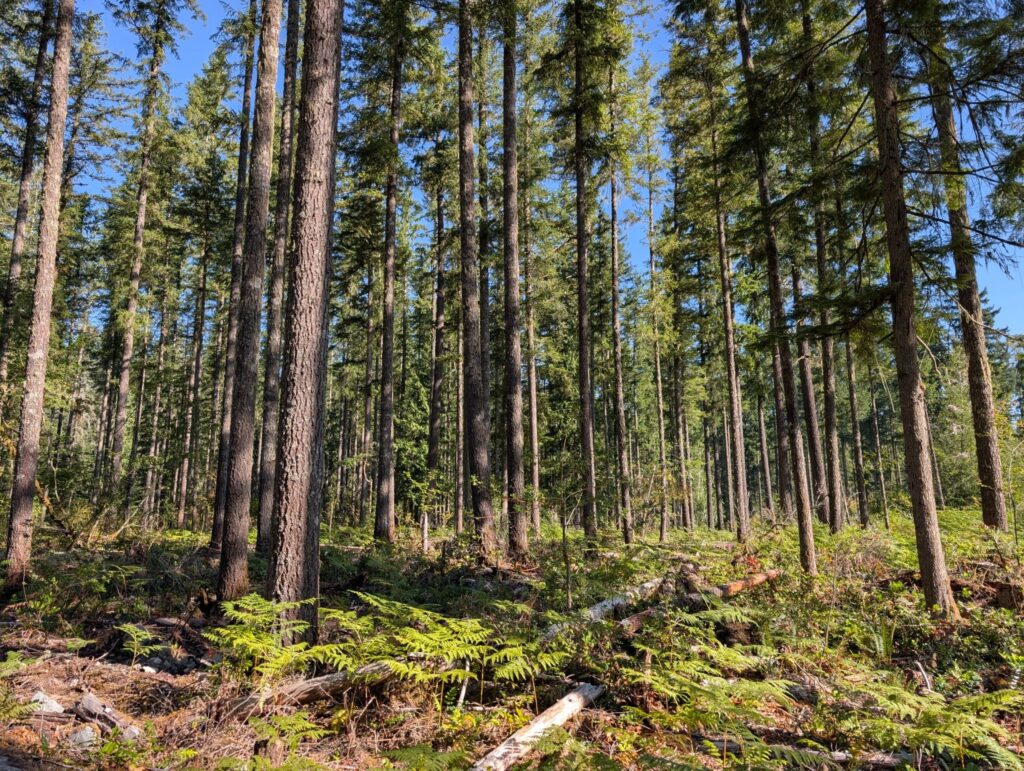
The Landsburg forest stand after its recent thinning.
SPU has several goals outlined in its forest management plan, but all are intended to support its core mission of providing over one million residents of the Seattle area with clean drinking water. The water coming from the Cedar River watershed does not require filtration, which is unusual for a metropolitan area. It’s a feat only possible because of the many careful measures put in place to ensure the watershed’s 90,000 acres are protected and well managed. Areas of the watershed have been highlighted in its management plan for priority forest management projects, including wildfire risk mitigation work in two areas near critical water supply infrastructure.
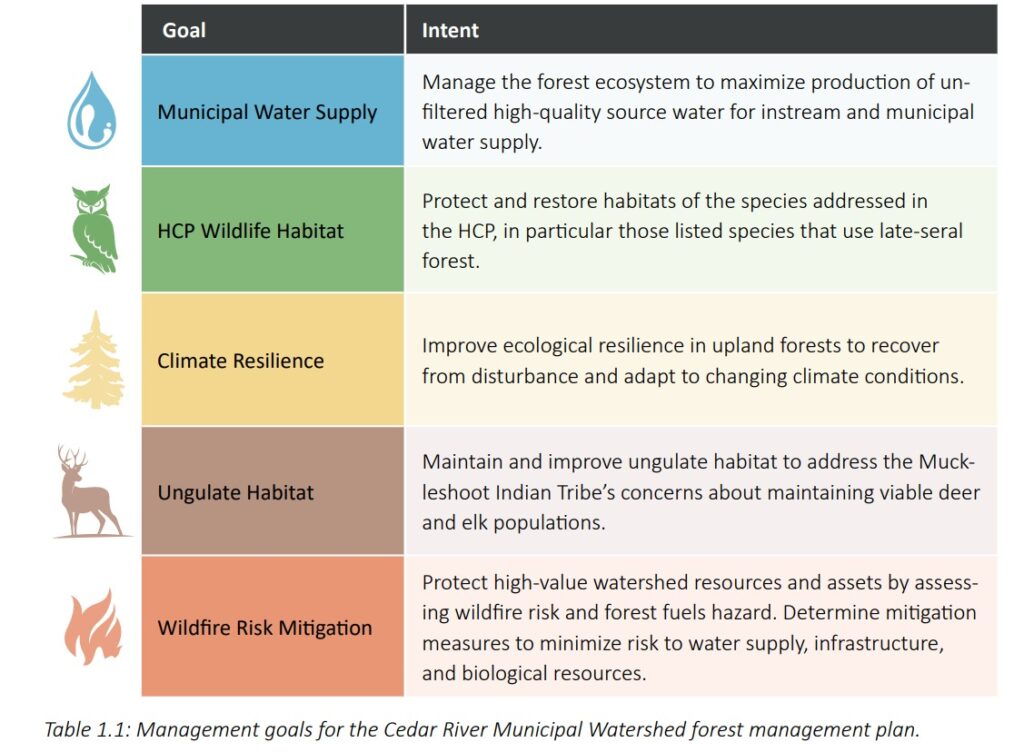
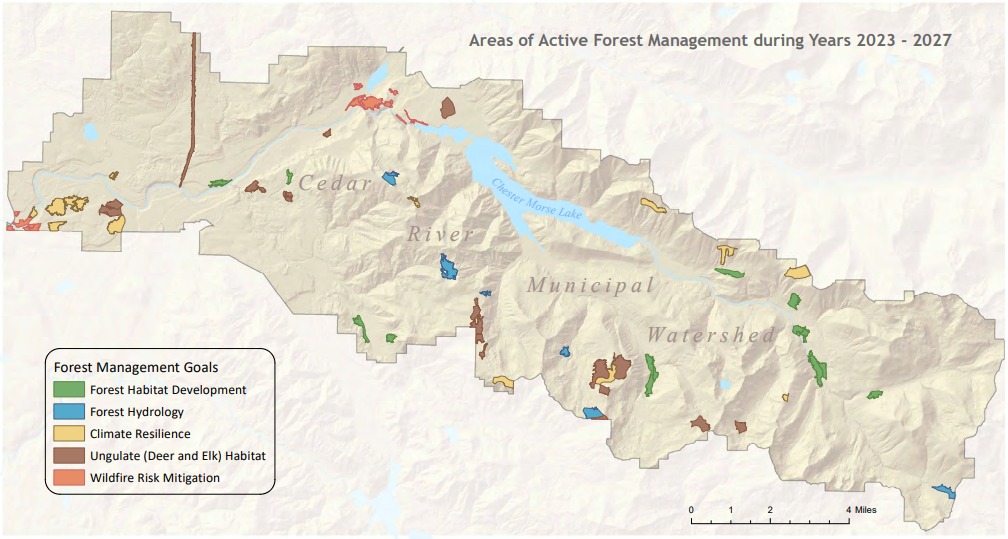
Management goals for the Cedar River Municipal Watershed forest management plan (2023-2027), and where they are planned on the watershed. The Landsburg thinning is highlighted in red on the far left side.
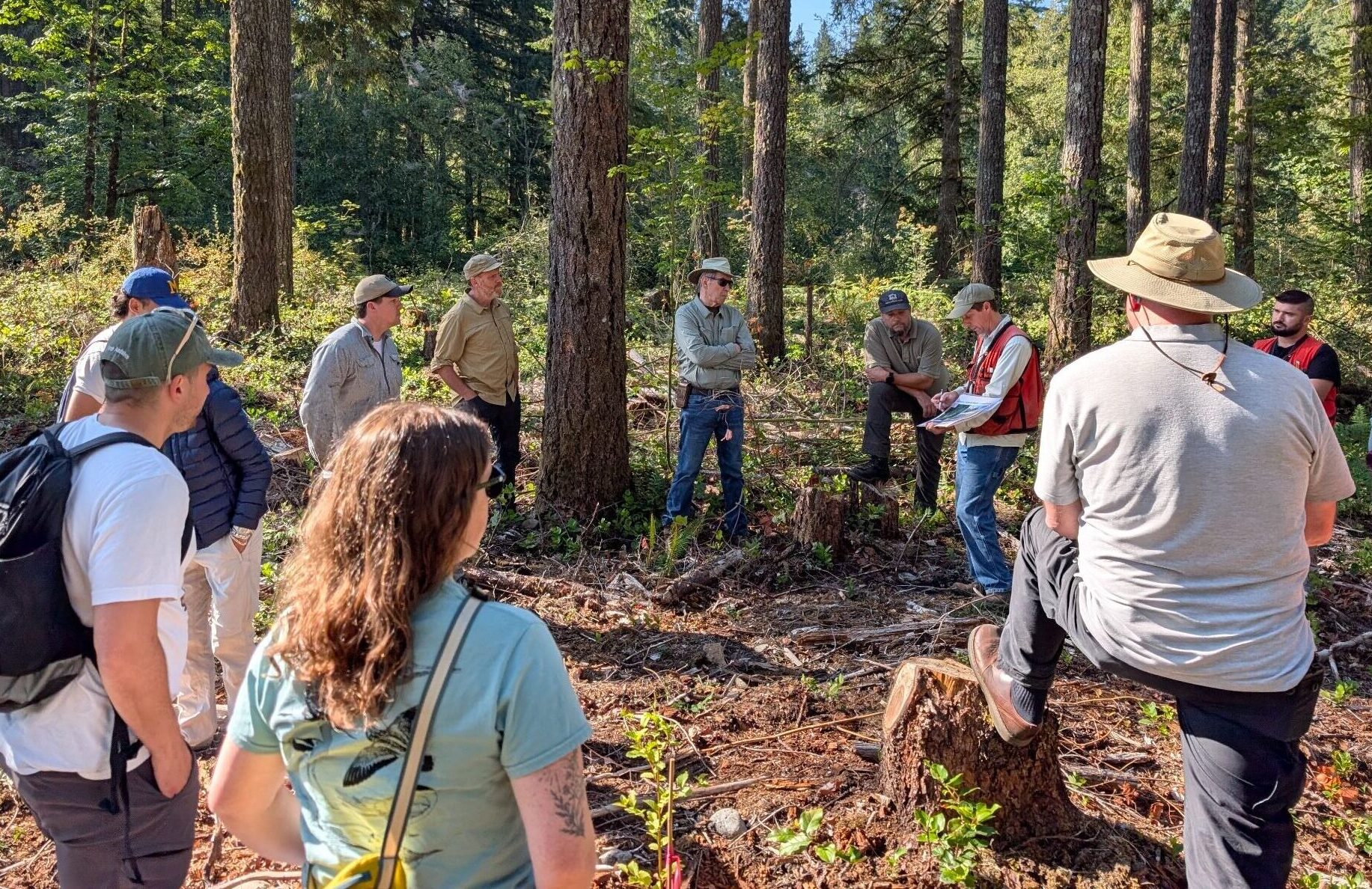
At an August forest tour near the Landsburg Gate, SPU Forester Jacob Oberlander led a group of participants through a recently thinned stand near the area’s diversion dam. The commercial thinning removed 20% of the stand volume, with the aim of creating 10-foot crown spacing to slow the spread of any fires that might reach the canopy. “We’re essentially creating a shaded fuel break in this area,” Oberlander says. The treatment also included “limbing up” the trees (cutting off the lower branches) and cutting back ladder fuels to reduce the chance that a fire would reach the canopy in the first place. While profit isn’t a motivating factor for harvest (and can’t be, by city ordinance), the harvested saw logs were high enough quality that the sale of surplus timber offset project implementation costs.
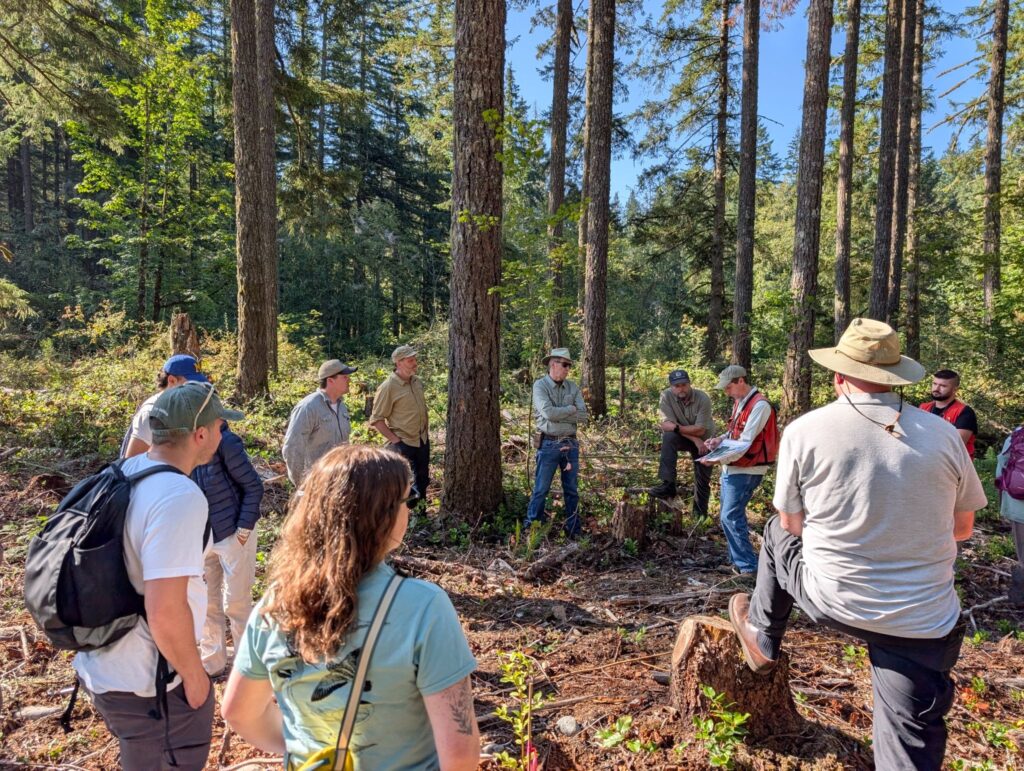
SPU’s Jacob Oberlander shares thinning details with workshop participants while Robert Swan looks on (pictured in orange vests).
NNRG Director of Forestry Kirk Hanson notes that this type of variable density thinning is common in forests in eastern Washington, but less common in western Washington. Due to climate and forest type, eastside fires tend to be more frequent and lower intensity than fires west of the Cascades, and the understory grows back more slowly, making eastside fuel reduction treatments more effective. “It’s harder to determine how best to reduce fire risk in westside forests,” he says. “The research is incomplete for forests west of the Cascades, and major fires over here tend to be more wind driven than fuel driven.” Forests on the west side of the state are incredibly productive, and the rapid accumulation of biomass means fuel reduction treatments don’t last long in most areas. There’s also a trade off with opening up the canopy, as more sunlight can increase growth in the understory.
It’s a tradeoff that Oberlander is familiar with. “This type of thinning is a treatment specific to the needs of this particular site, and will require a lot of upkeep and monitoring,” he says. “It’s not an approach that we can or want to apply to large areas of the watershed, that wouldn’t be feasible.” But around some of the critical watershed infrastructure, it allows his team to create defensible space that would buy valuable time and may prevent a minor fire from turning into a major fire. The fuel treatments for the defensible space combine three approaches, per the management plan:
- Removing flammable vegetation near critical infrastructure (the “Ignition Zone”)
- Separating horizontal and vertical fuel near the Ignition Zone (“Defense Zone”), and
- Creating shaded fuel breaks around the defensible space area as a buffer (“Shaded Fuel Break”)
SPU Forest Ecologist Robert Swan anticipated that the Landsburg stand would experience major changes even without the thinning. “We expect a long-term transition of the forest type in this low-lying area due to the changing climate conditions,” he says. The trees have been struggling, with pockets of root rot and some noticeable dieback in the Douglas-fir dominated stand, causing even more potential fuel for fires. Swan’s team has been planting a number of more root-rot resistant and drought-tolerant species in the thinned stand, including alder, Oregon white oak, ponderosa pine, and western larch. “We’re not phasing out the existing species, but we want to have some ecological infrastructure in place to help the natural processes along by providing a local seed source.” His team has monitoring plots and controlled observation trials in place to see how the different species respond over time.
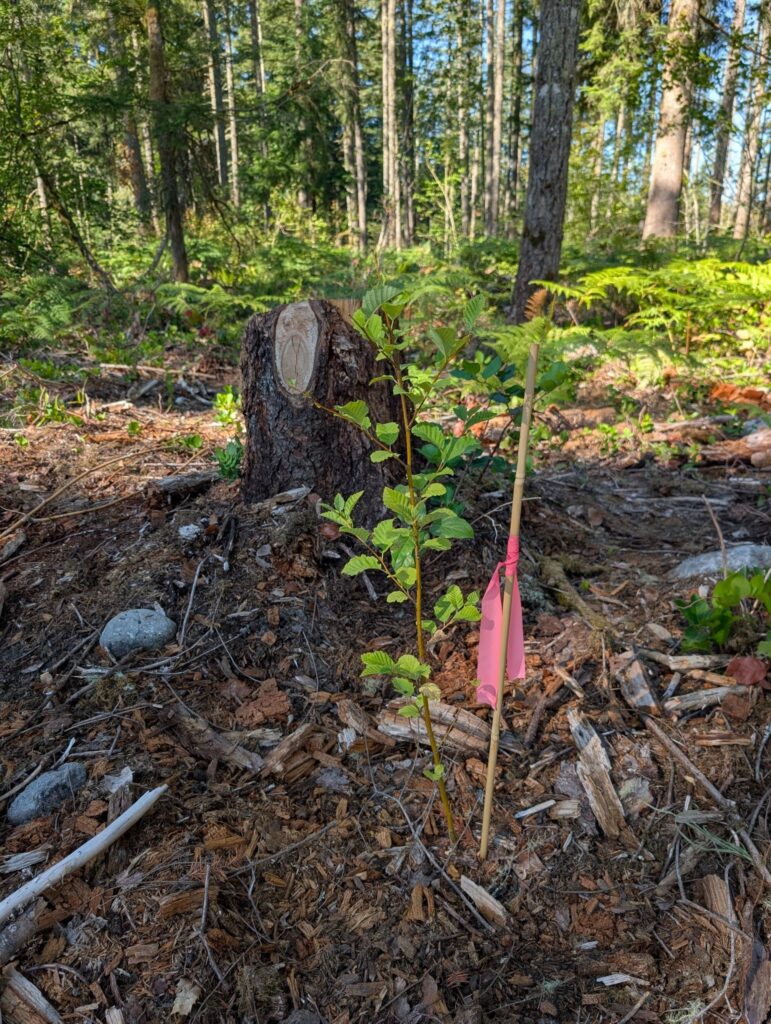
An alder seedling planted in one of the thinned area’s root rot pockets.
In addition to the forest management precautions, the watershed also has a wildland firefighting crew, drawn from staff volunteers. “We’re not fighting big fires, but we’re here to try to keep them from getting big in the first place,” Swan says. About two-thirds of his department has volunteered to train as wildland firefighters. Along with SPU’s dedicated firefighting team, they provide a initial attack crew to suppress fire starts, and determine if external support is needed. So far, most watershed fire starts have been kept to under one acre. “With the defensible space treatments, we’re working to reduce the potential impact of a fire to a critical water resource,” Oberlander says, “But we also hope they won’t be necessary.”
Leave a Reply