
Stewarding the Future
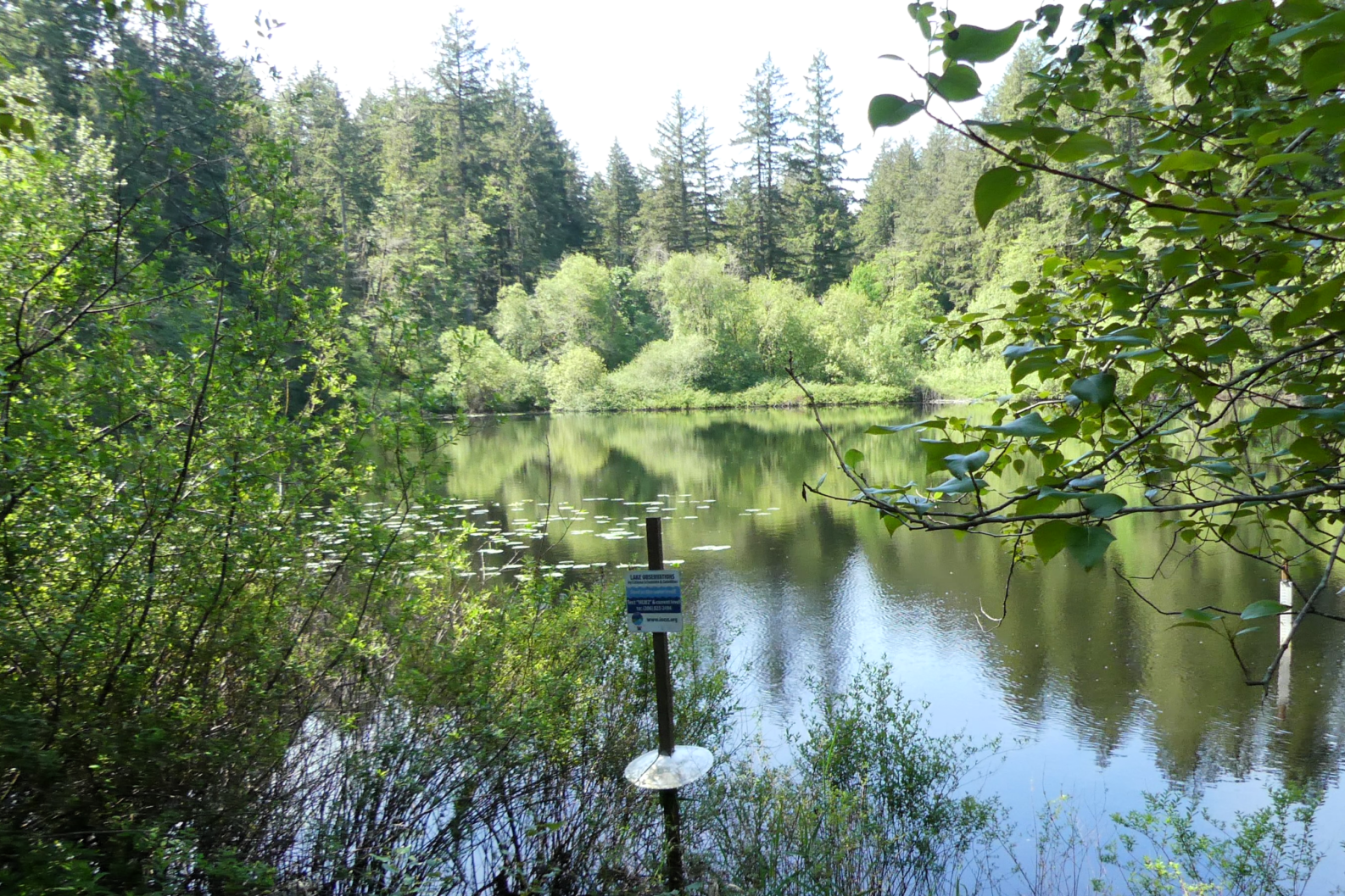
Upon arriving at Kit Ellis’s property, your first greeters might be the symphony of a dozen singing amphibians. “That would probably be the chorus frogs,” Kit says with a smile. At her forest in Gig Harbor, chorus frogs (or the ‘Pacific treefrog’), are one of many species Kit stewards. This month, we sat down with FSC certified forest landowner and NNRG board member Kit Ellis to learn how insights from her family’s 70 years of forest stewardship have informed her evolving approach to restoration.
Invasive Species management
Having resided on her 195-acre property since the 1950s, Kit is experienced in managing a variety of invasive species (or the introduced non-native plants which often outcompete native species), which may harm overall ecosystem health if left unmanaged. To protect her native habitat from this risk, Kit has worked to eradicate these invasive species for decades.
Walking along her forest’s winding road, Kit occasionally stops to pluck budding seedlings of the noxious weed Herb Robert emerging from the soil. “Its rudest name is Stinky Bob,” Kit explains, referencing the nickname that came from its pungent smell. Eradicating noxious weeds (a category of highly aggressive, invasive plants as defined by Washington State), remains one of Kit’s main management goals: “I’m trying to go for more plants that are good and fewer of the noxious weeds.”
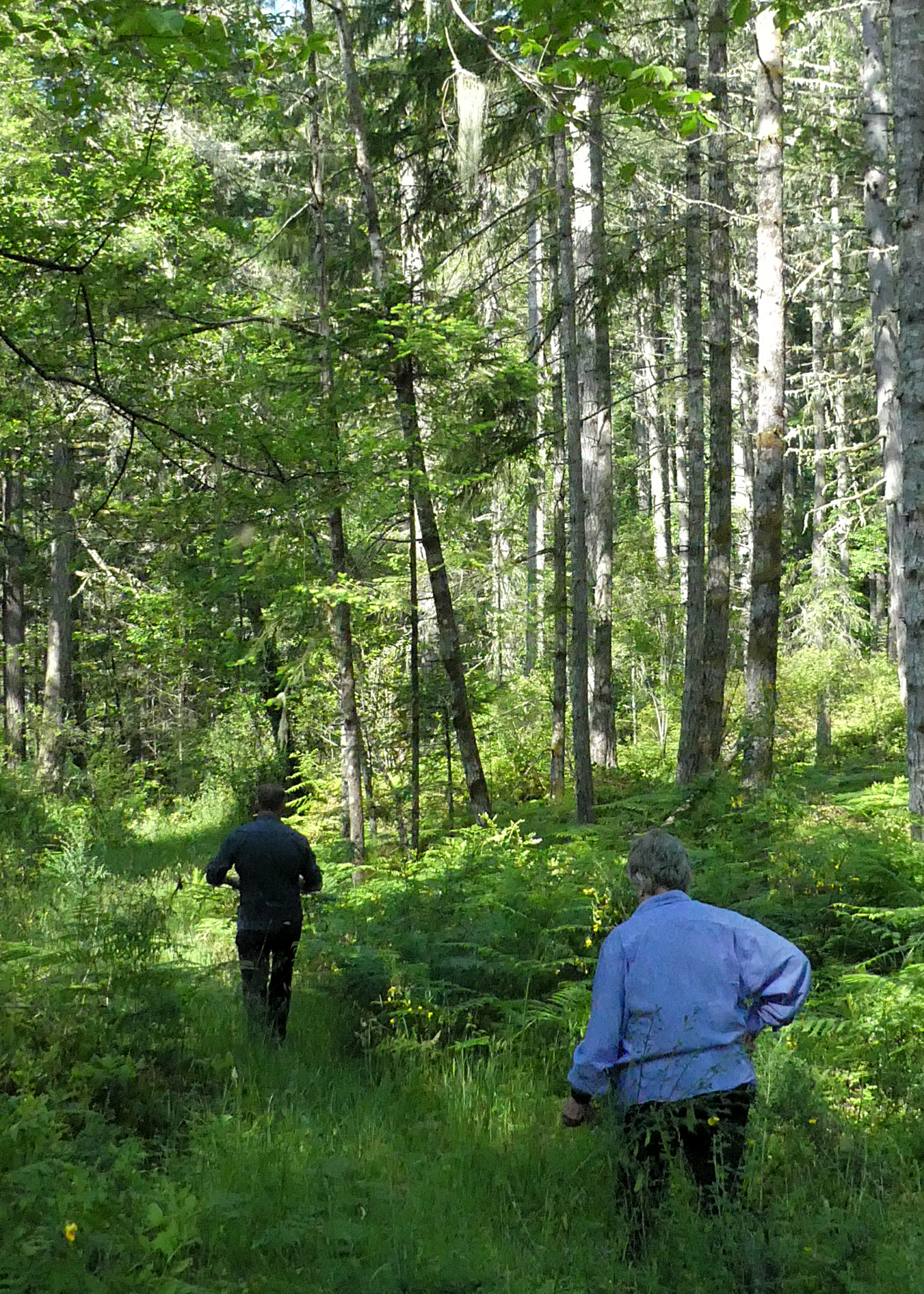
Kit Ellis (right) with a handful of Herb Robert, accompanied by NNRG Director of Forestry Kirk Hanson (left).
Kit’s other noxious weed nemesis? Cytisus scoparius, or scotch broom. Recalling the landscape when her mother (Phyllis Ellis) first purchased their property in 1956, Kit says, “If I found pictures of what this looked like when we first moved in, this would have [primarily been] tall scotch broom. Walking through, it was misery in the summer. Because when the seed pods are ripe, they break and shoot the seeds at you. Plus, it’s a terrible fire hazard. They’re so oily.” Gazing upon the vast Douglas-fir woodland now stretching across Kit’s land, it’s difficult to imagine her property once dominated by scotch broom.
Thanks to Kit’s careful stewardship, that seamless restoration outcome is by design. While scotch broom can establish in shady forest understories, its seedlings thrive best in full sun and disturbed sites. Today, mechanical scotch broom removal and shade from the forest canopy prevent the scotch broom from spreading further.
However, another invasive still requires active management on Kit’s land: English holly. Though holly removal commonly entails cutting down the tree and either removing the root system or applying a topical herbicide as needed, Kit highlights her holly trees’ close proximity to water. Because herbicide use is often prohibited near water, Kit needed a safer method to manage the large, stubborn holly trees. Enter, EZ-Ject Lances. This injectable herbicide directly targets selected species with minimal risk to surrounding vegetation. Pointing toward her lake, Kit adds, “the advantage of that is that the herbicide is approved for use by, and even in, water.”
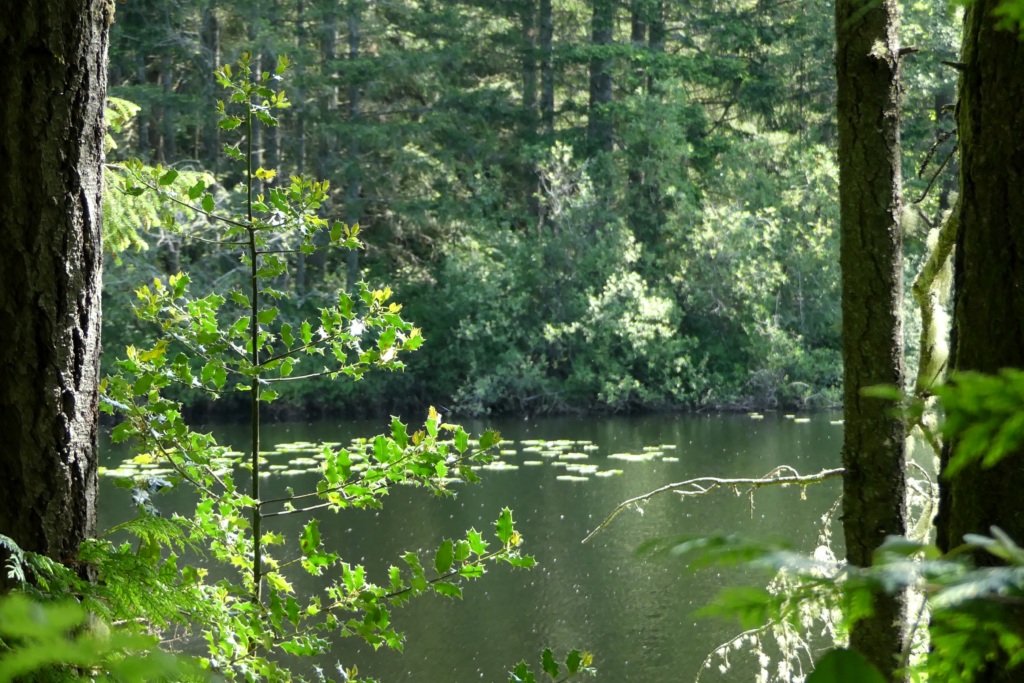
A young English holly tree growing near Kit’s lake.
According to Kit, her mother (Phyllis) was not a trained forester, yet understood the importance of diverse forests. “I think my mother worked all day, every day, cutting back [invasive] blackberry. I don’t know what she was working on in terms of noxious weeds. Scotch broom is an obvious one. Our ideas have changed somewhat as we identify new noxious weeds that weren’t a problem before.”
Himalayan blackberry (one of the most notorious invasive species in the Pacific Northwest), was not listed as a Class C weed by the Washington State Noxious Weed Control Board (NWCB) until 2009 – decades after Phyllis first managed the species as an invasive. In 2025, English holly earned the same classification after public response urged NWCB to reconsider its status. As scientific understanding evolves and factors like climate change reshape how we understand invasive species, restoration practitioners must remain informed of how to best protect increasingly vulnerable ecosystems.
Like Phyllis, Kit’s keen observations will continue to inform her invasive management approach as the forest grows and species composition similarly evolves.
Habitat restoration
Alongside invasive species removal, Kit manages multiple, ongoing restoration projects to cultivate native plants, improve biodiversity, and increase wildlife habitat on her property. In fact, she says that habitat restoration remains her primary management objective: “It was so important to my mother that I just inherited that.”
To create a thriving and more diverse forest ecosystem, Kit has planted hundreds of native seedlings across her land. Notable species include Western redcedar, ponderosa pine, Oregon grape, sword fern, mock orange, and red flowering currant, which each improve the structural and compositional diversity of her forest. Planting natives also often results in reduced water, herbicide, and pesticide usage, the decreased spread of invasive plants, and fewer long-term maintenance costs for landowners.
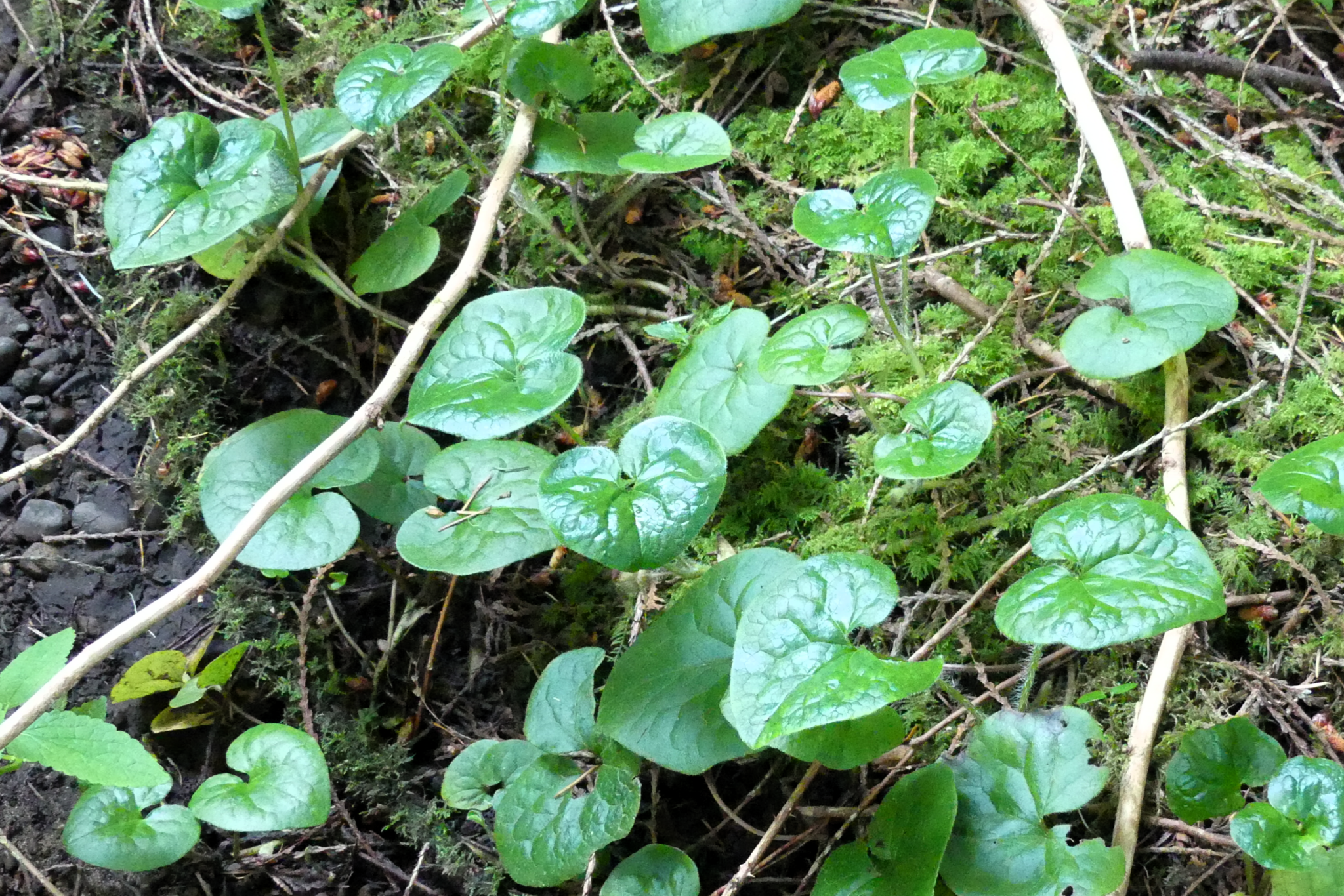
Wild ginger supports thriving arthropod and pollinator populations.
Likewise, these native plantings promote the diversity of her land’s fauna. As native species, Kit’s plantings attract a wide variety of pollinators, pest-eating insects, birds, and small and large mammals. To further enhance wildlife habitat, Kit has also constructed various wildlife boxes, snag cavities, and water catchments. As a result, Kit has spotted a vast assortment of wildlife over the years, including black bears, mountain beavers, river otters, wood ducks, bald eagles, flickers, bats, pond turtles, and frogs. “I’m particularly eager to save big trees with big cavities in their bark where a little bat could find a good perching place,” Kit says.
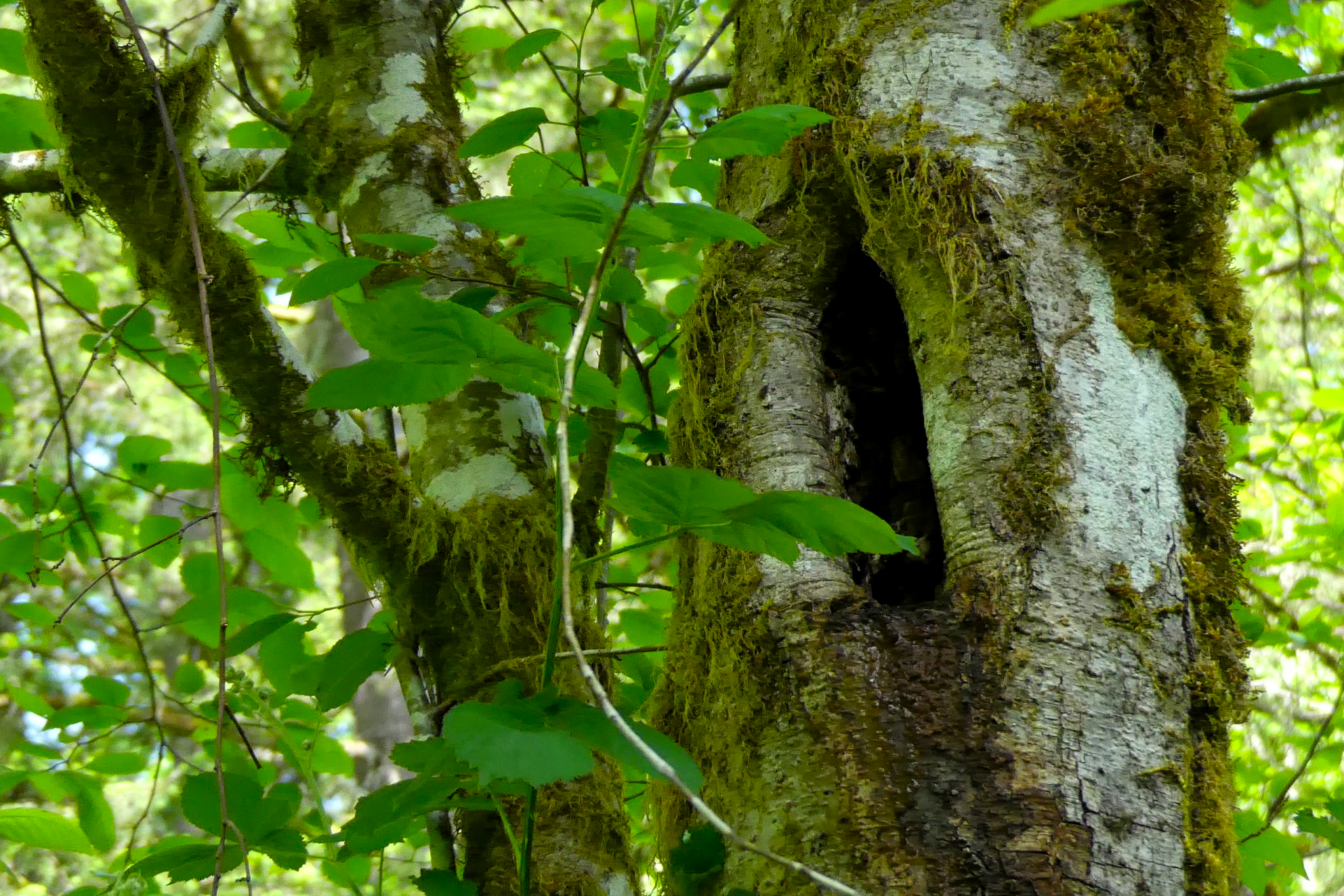
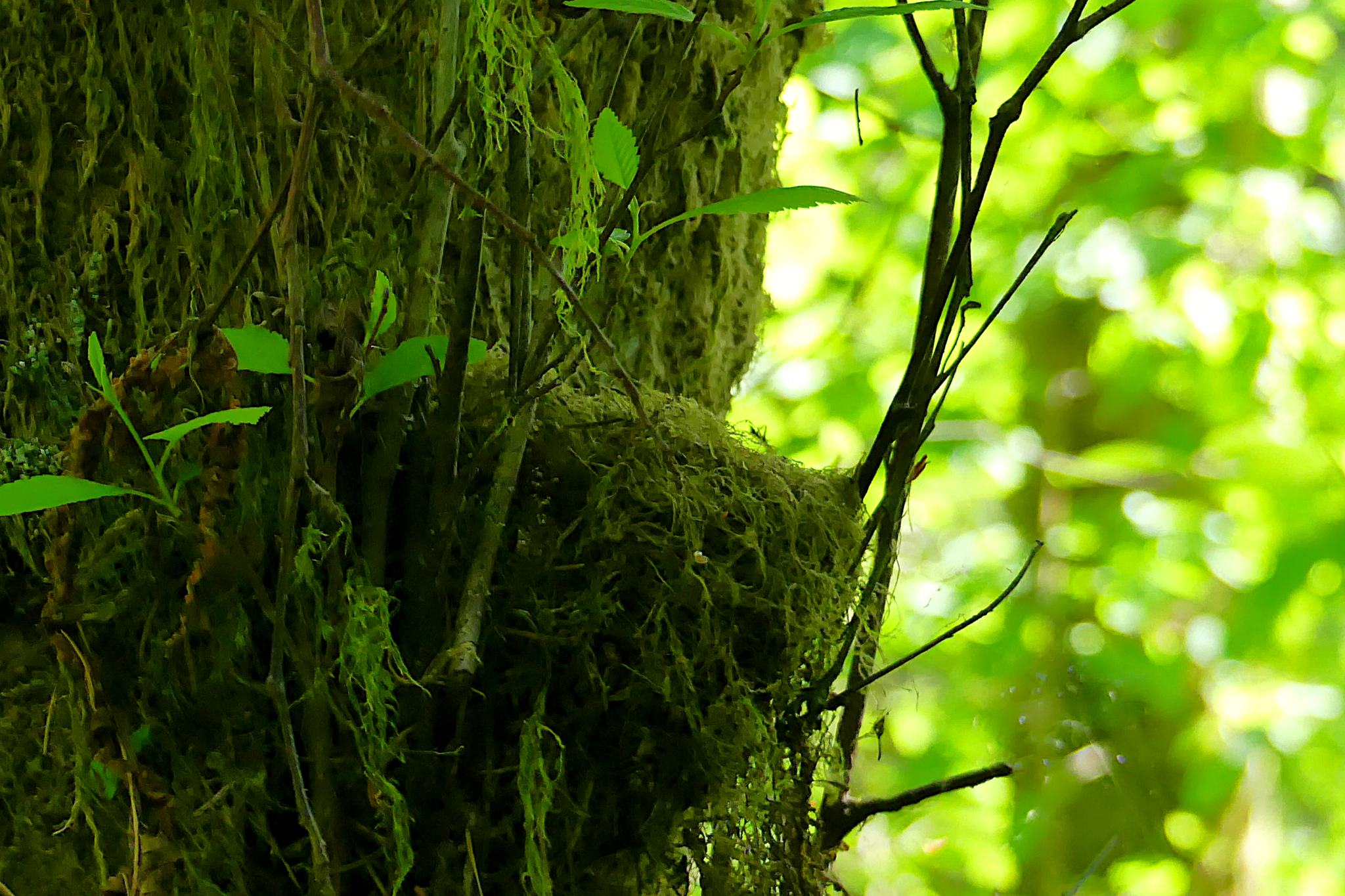
Naturally-occurring tree cavities and branch clusters provide important wildlife habitat to birds and small mammals.
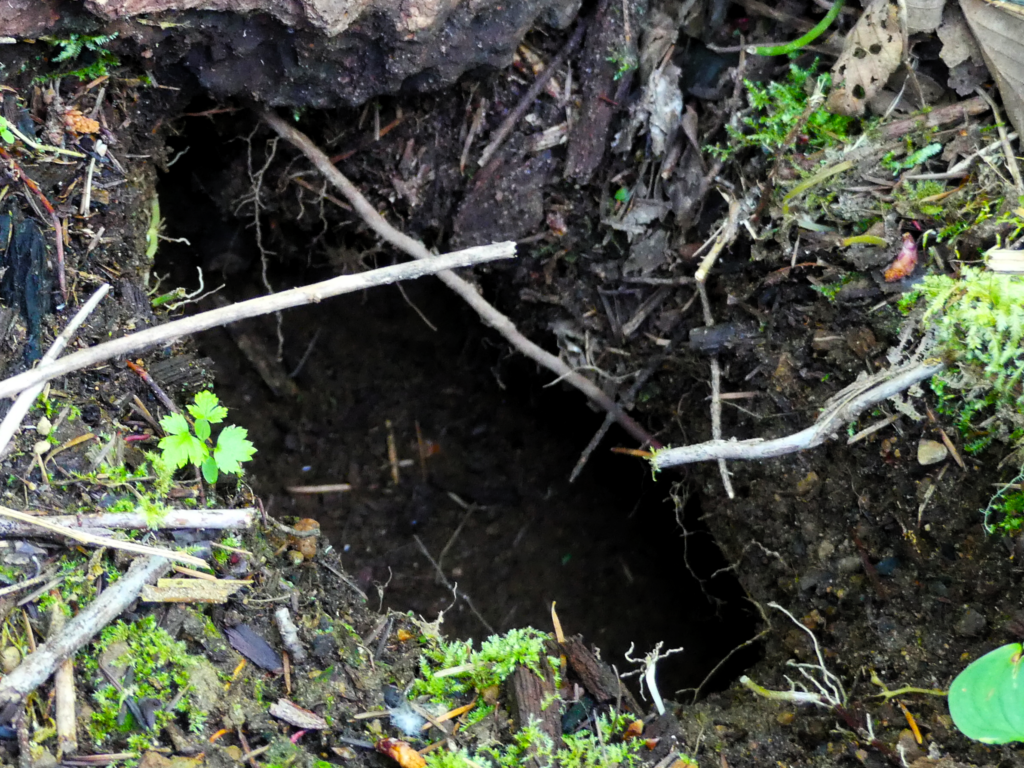
Dozens of mountain beaver burrow entrances indicate an extensive underground tunnel system.
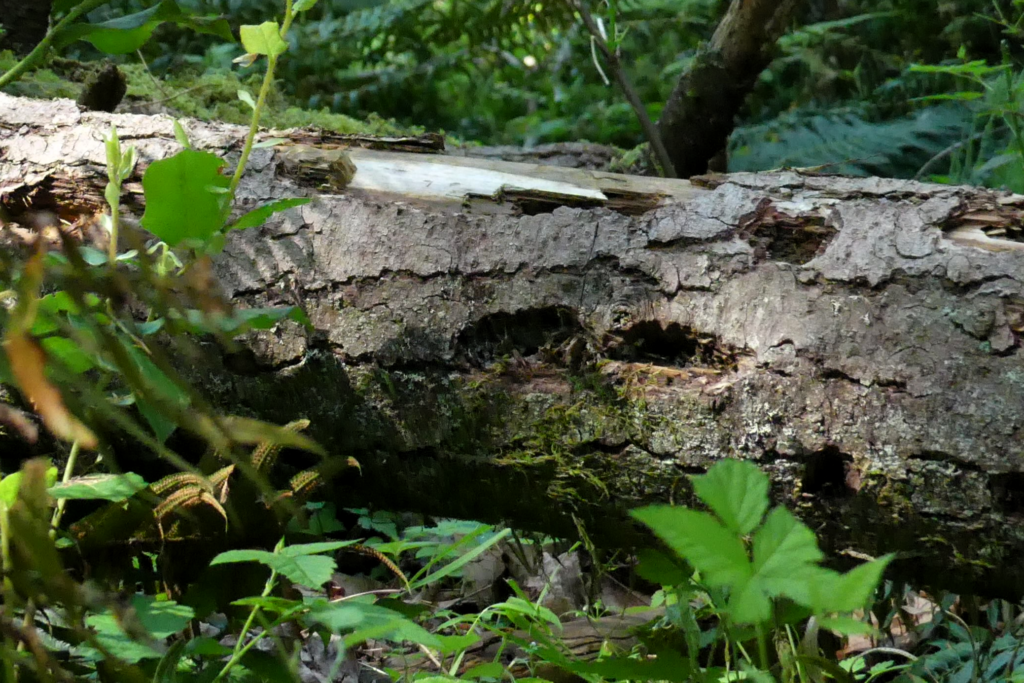
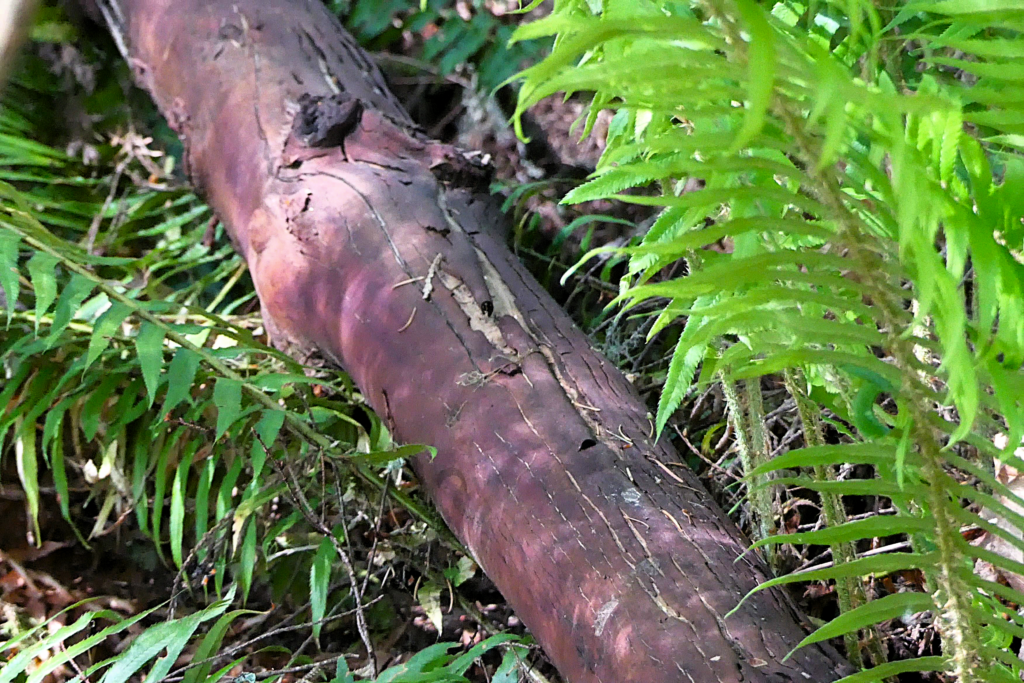
Fallen logs and branches support excellent microsite diversity, ensuring ample shade and moisture for fungi and insects.
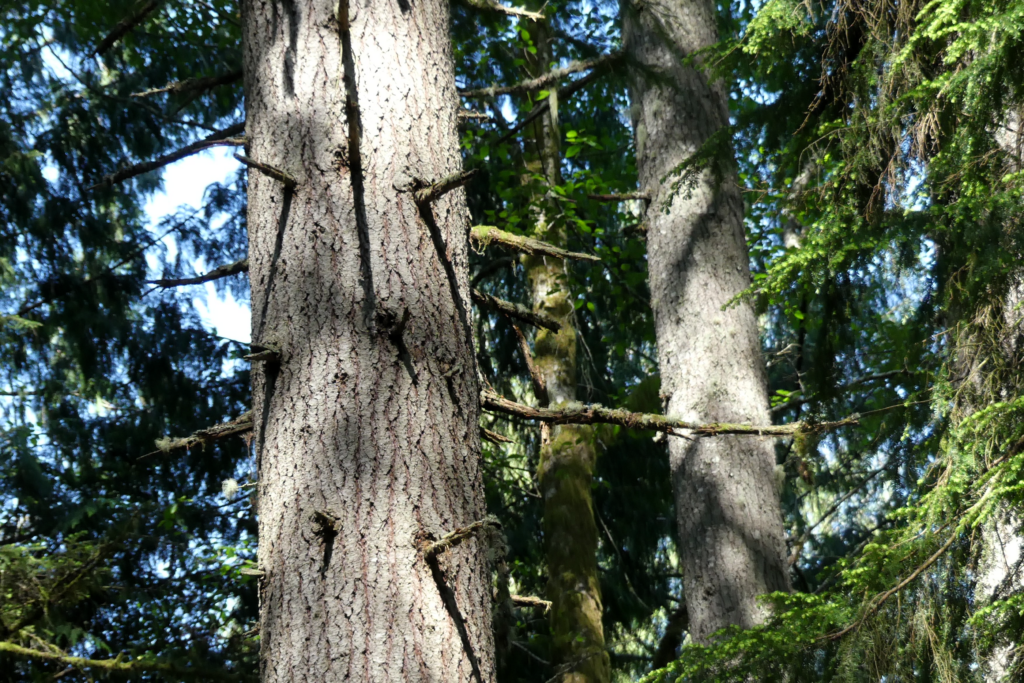
Bare Douglas-fir branches provide excellent perches for birds, squirrels, and chipmunks.
But with nearly 200 acres of forest to manage, knowing where to start can be a challenge: “I go after things that look out of balance, or they catch my attention…I’m always vacillating between ‘do no harm’ and ‘do something’. Each day, I land differently on that scale.” Kit concludes by stating, “I put my energy [into the projects] more likely to get me to where I’m trying to go.” Of the different restoration sites on her land, she jokes, “I guess in its own way, it speaks to me and says what it would like. And if it’s lucky, I say, ‘oh, okay, I hear you’.”
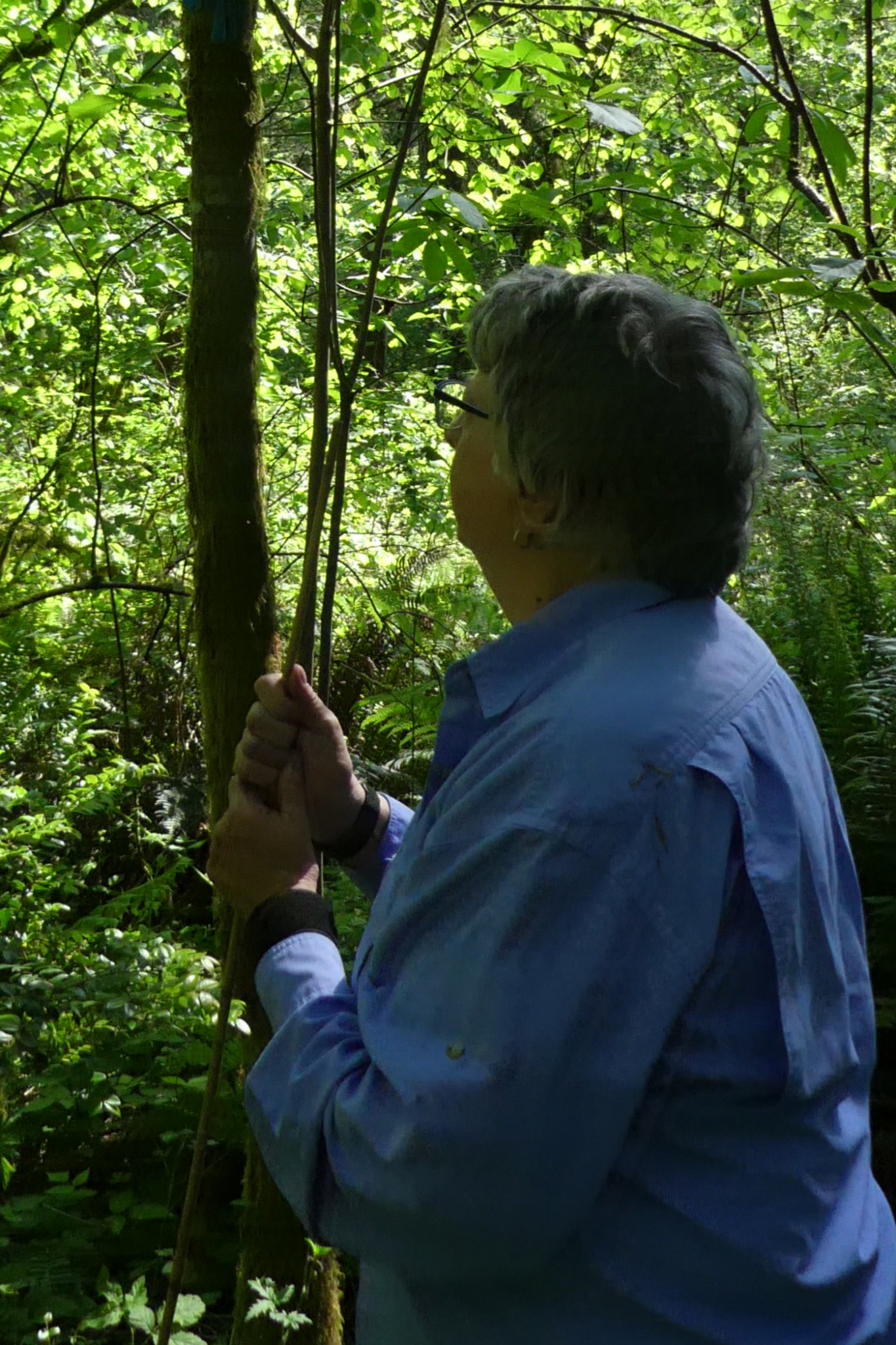
Kit evaluates a tree’s health and growth.
Legacy
In addition to her current habitat management plans, Kit has worked to protect her land for future generations. In reflecting on her own life’s work, she encourages everyone to seek out new opportunities to make a difference.
For Kit, part of that difference included placing a conservation easement (CE) on the property. “We’ve been trying to guarantee that [this property] will stay a forested land with great habitat for the native wildlife,” she explains, “I’d like it to be a sort of a jewel that is recognized for its special attributes.” Kit was a founding member of the Peninsula Heritage Land Trust, one of the four volunteer-led land trusts that merged to form the Great Peninsula Conservancy (GPC) in 2000. Later, she served as president of its board. Today, she remains an active committee member of both GPC and Pierce County Conservation Futures Citizens Advisory Board, and serves as a trustee for Girl Scout Camp St. Albans. Kit was also awarded the Gary Allen Cunningham Conservation Award by GPC in 2022, in recognition of her lifelong dedication to local environmental and land stewardship.
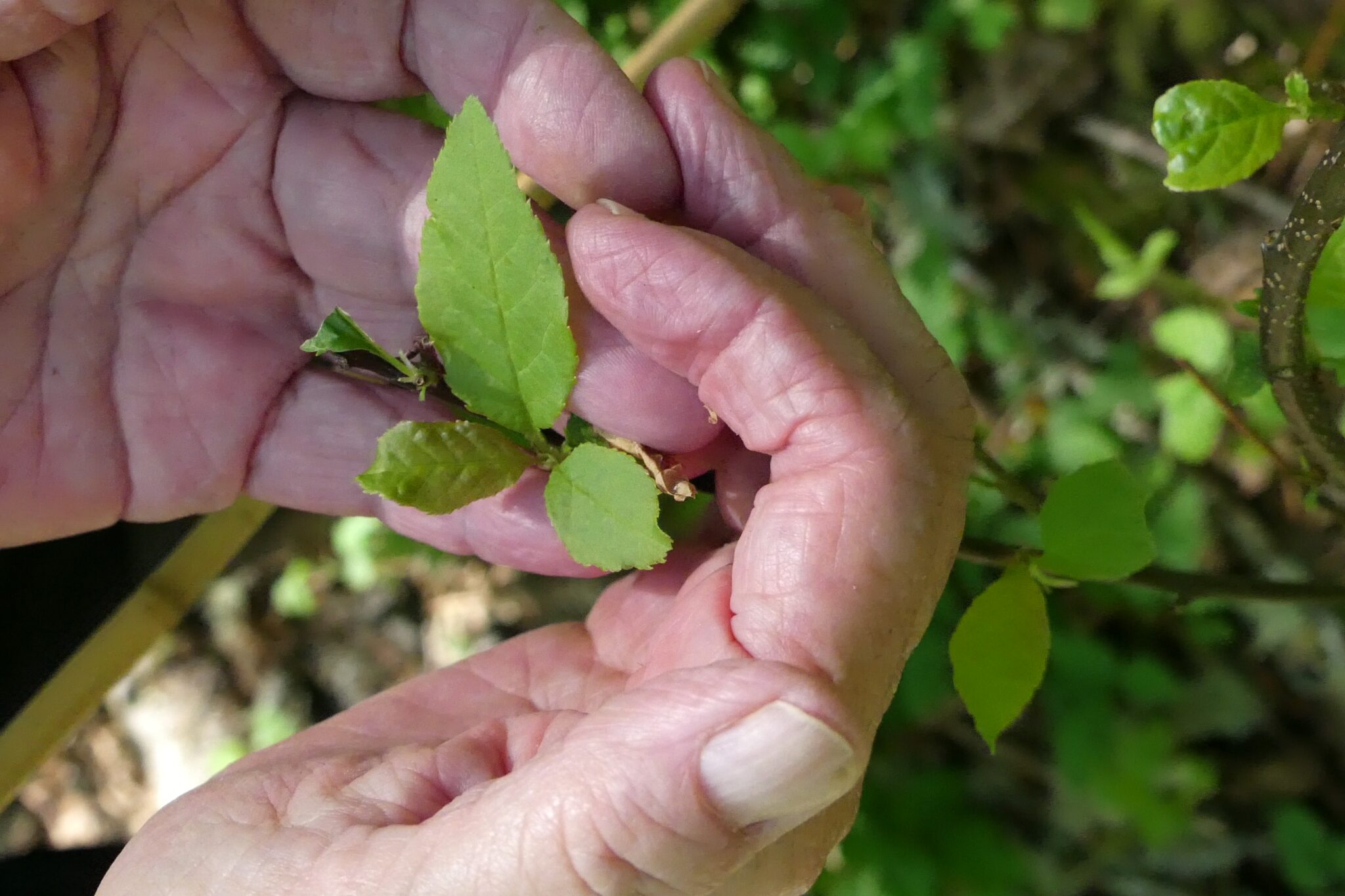
Kit holds the budding leaves of a Pacific Crabapple seeding.
“Talk to everyone you can,” she concludes, “Ask their opinions. Take as many opportunities as possible to learn more. Volunteer, so you hang out with people who are already involved in it.” Whether a forest landowner or not, Kit also encourages everyone to evaluate their own goals for involvement. “I’m a great believer of asking your basic question to as many [people as] possible. The odds are good that somebody will say, ‘I know somebody who might be just who you’re looking for’. It takes collaboration. It really does.”
Next month, our encounter with Kit continues as we discuss her assisted migration restoration project designed to protect her land’s biodiversity amid a changing climate.
Leave a Reply