
Redwood Trees…in Gig Harbor, WA?
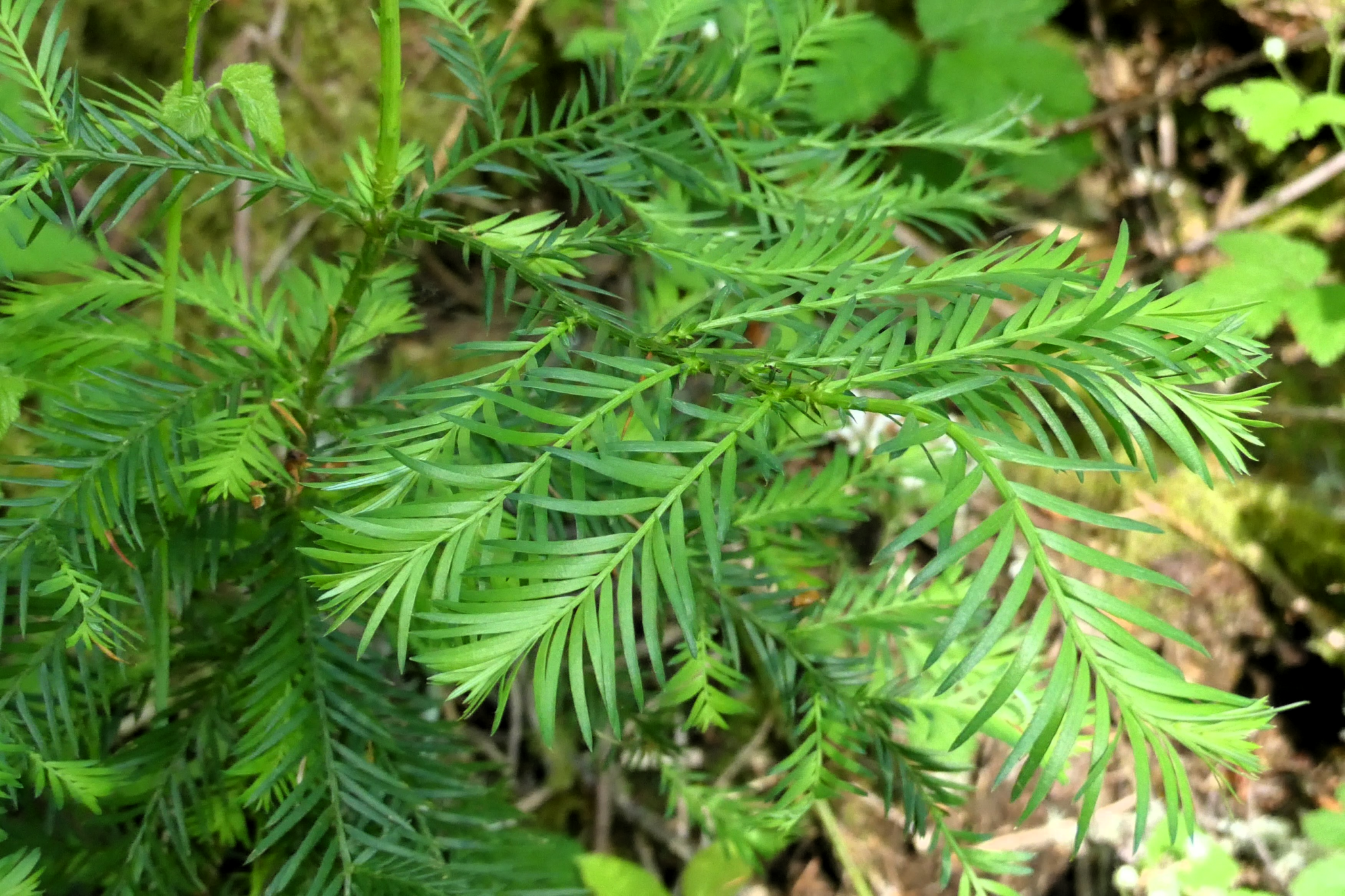
Last month, we sat down with FSC certified forest landowner and NNRG board member Kit Ellis to learn how insights from her family’s 70 years of forest stewardship have informed her evolving approach to restoration. This month, we’ll learn how Kit’s redwood seedlings might be one answer to helping her forest survive hotter temperatures and longer droughts caused by climate change.
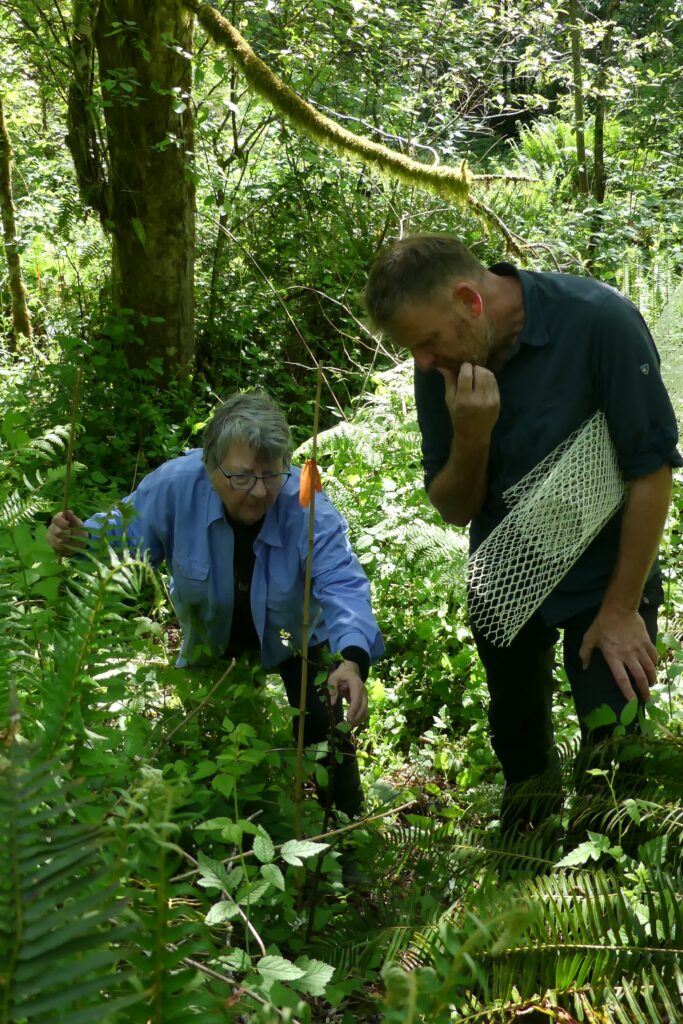
Kit Ellis (left) and Kirk Hanson (right) discuss tree seedling survey results in Kit’s forest.
Droughts, Climate Change, and Forests
Kit Ellis is well aware of the need for proactive and responsive land management amid a changing climate. On her property, Kit records and submits her lake’s daily depth to the Lake Observations by Citizen Scientists and Satellites project. As a citizen scientist, her data helps researchers monitor the everyday impacts of climate change. The remnant of a glacial tarn which formed after the last ice age, Kit’s lake recharges by rainfall and drains into nearby Wollochet Bay. “Mom called it the headwaters of the Pacific,” Kit says proudly.
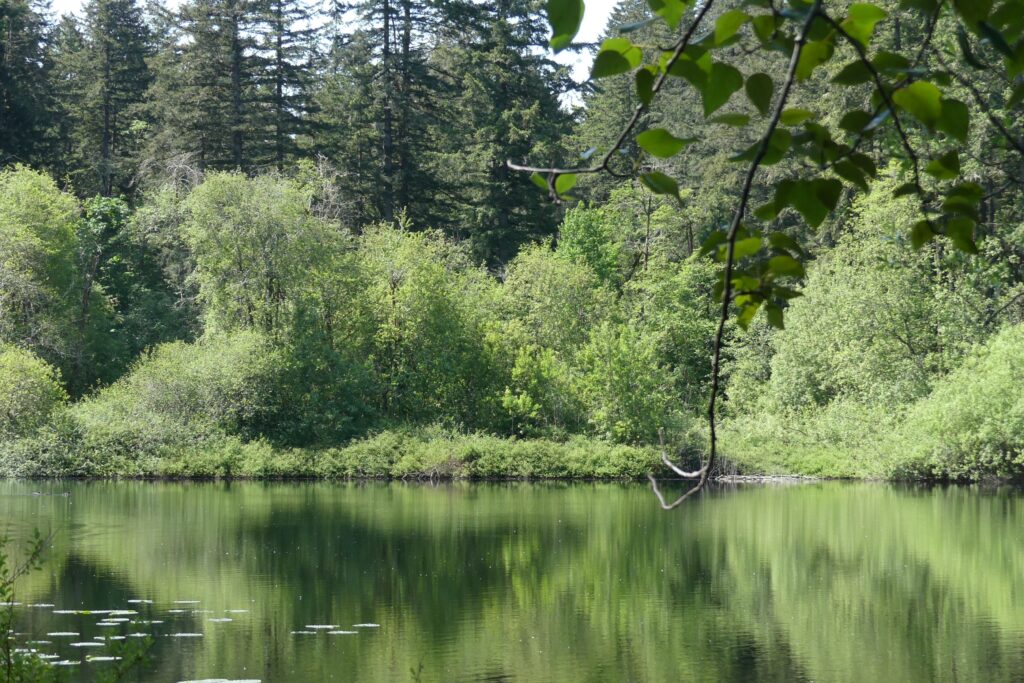
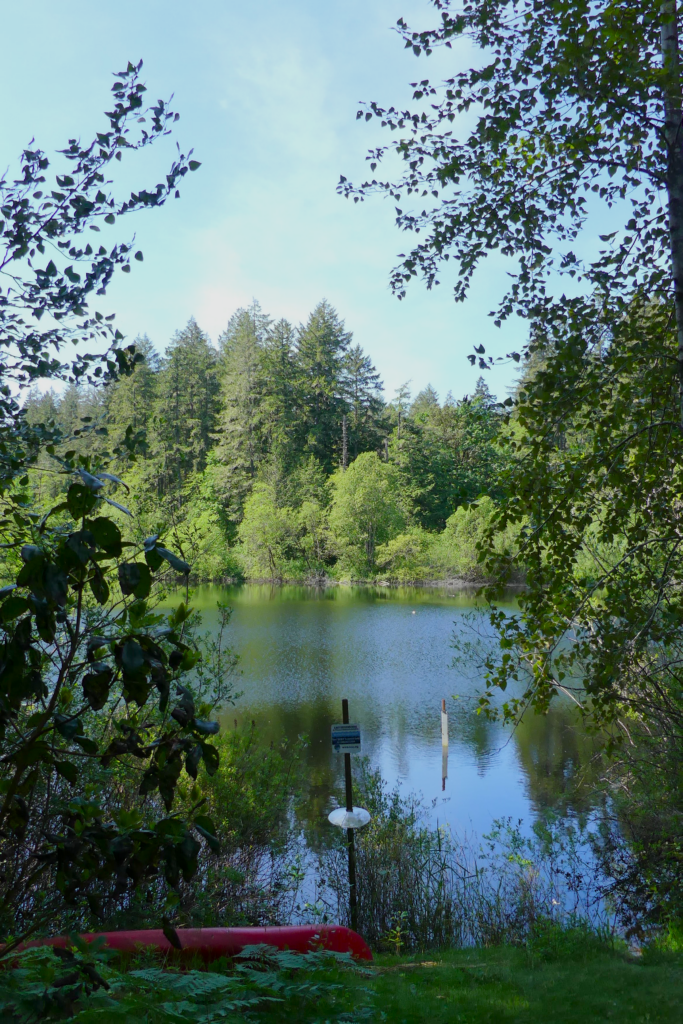
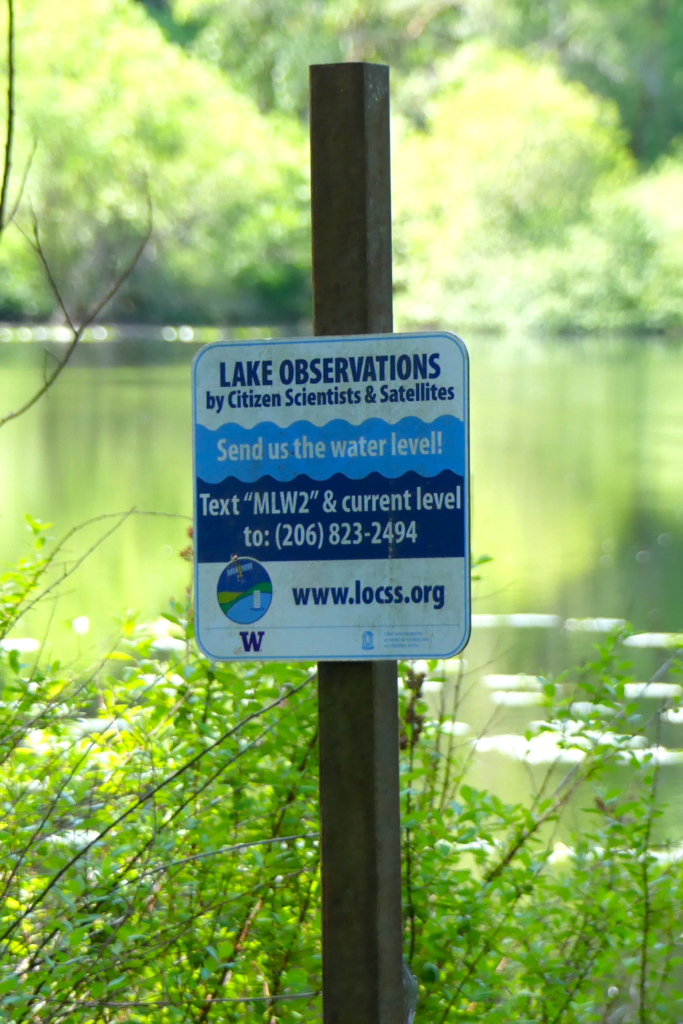
Views of Kit Ellis’ lake.
But today, these headwaters are drying out quicker than usual. Last year, Kit’s lake never fully recharged. Year after year, the lake’s depth shrinks.
“This year, all the blooming and leaves opening up, seemed to [happen in a] compressed number of days from closed tight buds to practically gone. The dogwoods, flowers, long gone now,” she says. “I think it’s going to be a problem trying to keep forests healthy. Old principles of how things should be done have to be changed a whole lot, or we won’t have healthy forests.”
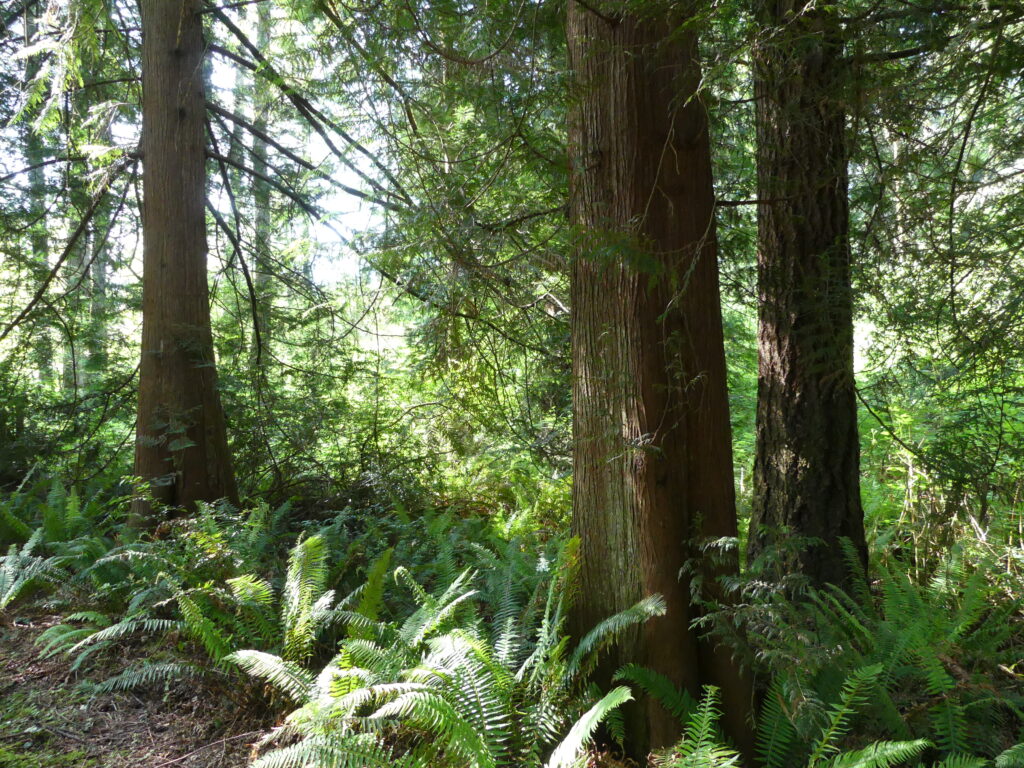
Douglas-fir and western redcedars shade the sword fern understory in Kit’s forest.
Kit is not alone in her fears. As human-caused activity exacerbates rising temperatures, restoration practitioners must identify new, innovative ways to bolster ecosystem resilience to climate change. In the Pacific Northwest, declines in Douglas-fir and western redcedar populations signal the ever-present urgency of the climate crisis.
To ensure the long-term structural and species diversity of her forest, Kit and the NNRG team are experimenting with new methods to increase her forest’s health and drought resilience. Their newest restoration technique? Planting western redcedar from southern Oregon and redwood seedlings from California.
Assisted Migration
Assisted migration (AM), or the human-assisted movement of species outside their native range, aims to establish new plant materials with increased resilience to climate change. Assisted species migration, a subtype of AM, is the human-assisted movement of plant materials far outside their native range (to areas the plants could not reach through normal dispersal). Because individual plant phenology, morphology, and growth are shaped by genetic variation, natural selection increases plant survival if the given environment favors the plant’s genotype differences. As extreme temperatures and droughts continue to threaten the survival of species like bigleaf maple, western red cedar, and Douglas-fir in the Pacific Northwest, some restoration practitioners are implementing AM as one method to preserve the structural diversity of PNW forests.
By establishing western redcedar and redwood plant propagules outside their native range (from a warmer to cooler climate), Kit’s experimental AM project intends to increase her forest’s resilience to climate change. Designed by NNRG Director of Forestry Kirk Hanson, three species varieties were sourced for Kit’s AM project: local western redcedar from Washington Department of Natural Resources’ Webster Forest Nursery, climate-adapted western redcedar from Fourth Corner Nursery in Bellingham, WA and redwood seedlings from PNW-based non-profit PropagationNation.
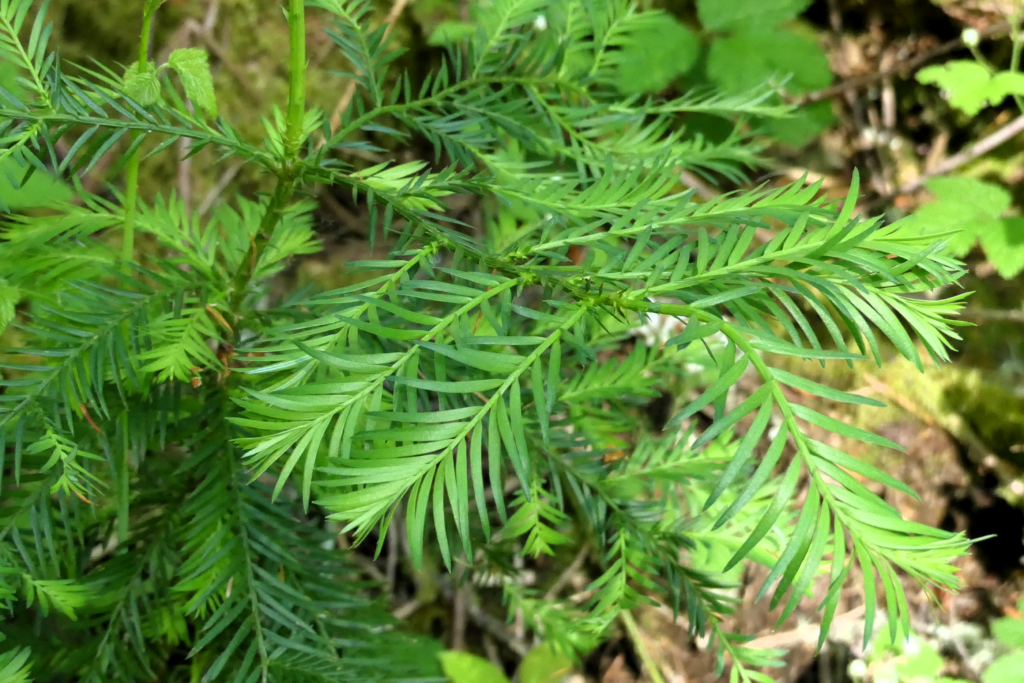
A redwood seedling from the assisted migration project on Kit Ellis’ property.
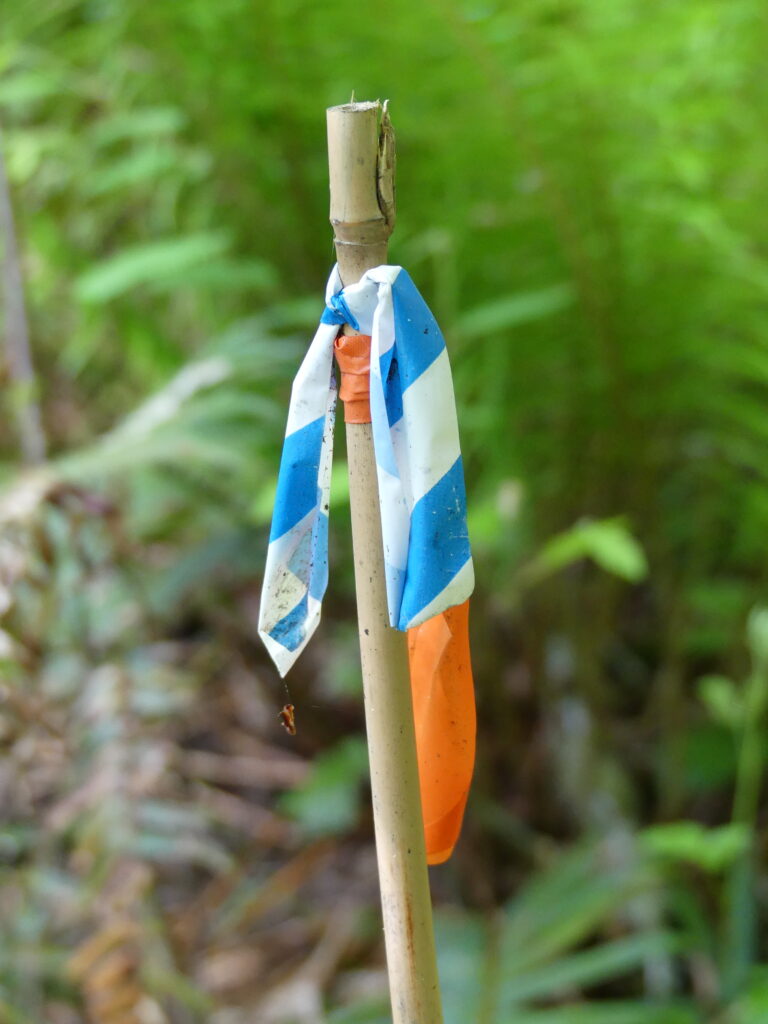
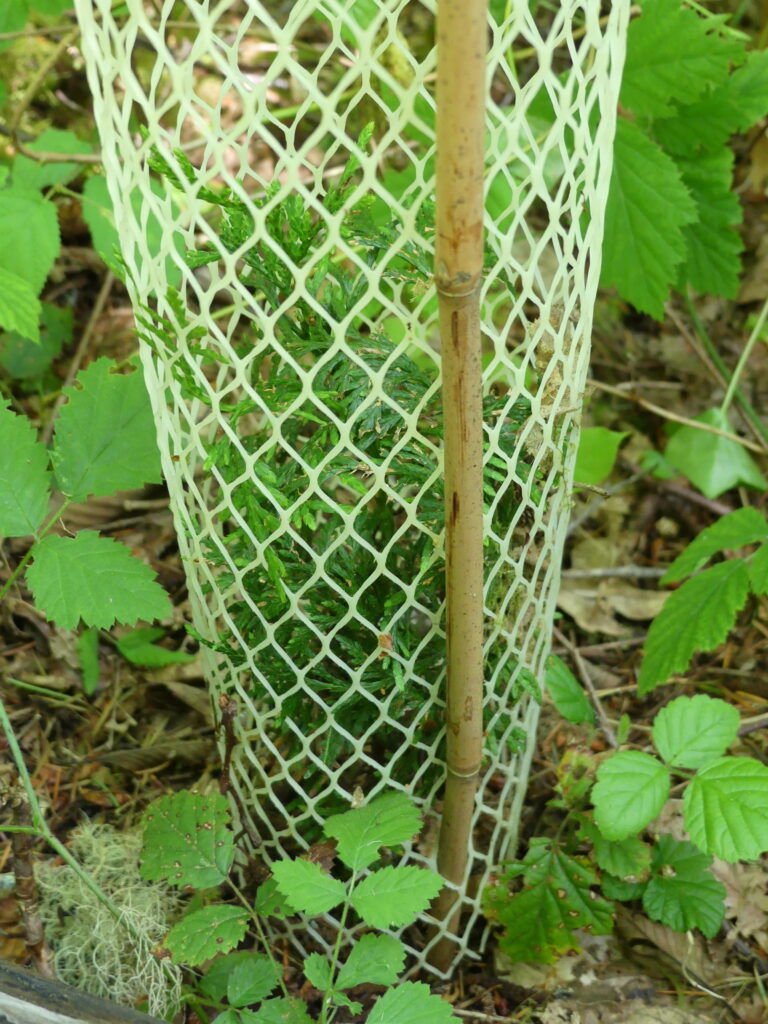
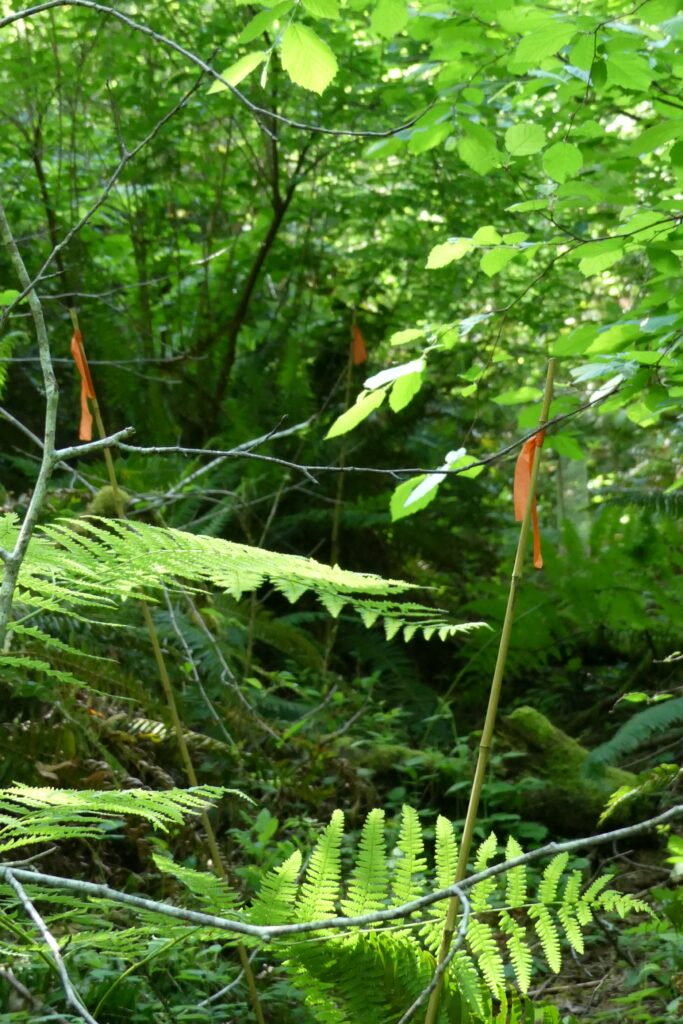
Dual color ribbons indicate the planting location of an assisted migration Western redcedar seedling (left, center), while single orange ribbons indicate the planting locations of native seedlings (right).
As a young and experimental project, it remains too soon to determine the ultimate success of the Kit’s planting project. In the coming years, NNRG foresters will continue surveying the results of seedlings, providing a clearer picture of the project’s success. Until then, Kit’s experimental design shows promising results for the survival of the redwood seedlings. When compared to the mortality observed in both the local and climate-adapted redcedar populations, nearly all redwood seedlings exhibit bright new growth. According to Kirk, Kit’s experimental design is his third AM project to date. Though it’s too soon to determine the success of his other two AM projects, he says the assisted migration seedlings across all three sites are surviving well.
Right plant, right place
In preserving the structural diversity and long-term resilience of Kit’s forest, Kirk says that “these assisted migration seedings represent a small percentage of total planting stock”— overall, less than 10% of total seedings planted. Of the western redcedars alone, 80% were locally sourced in Washington. The remaining 20% were climate-adapted seedlings.
For both economic and ecological reasons, Kirk cautions that non-native species should not be the primary species planted. According to Kirk, because there are no mills that buy redwood logs in the Pacific Northwest currently, there is little commercial timber value from planting redwood seedlings. As an ecological forester, Kirk encourages landowners to understand the needs and considerations of their specific forests. He advocates that landowners prioritize planting native species, learn their forests’ microclimates and soils, and apply this knowledge to any planting decisions made.
At Kit’s property, laminated root rot (a fungal disease endemic to the Pacific Northwest) remains an active management consideration for her Douglas-fir forest. Though commercial thinning may effectively reduce the root rot’s spread, planting diverse (native) tree species immune or not susceptible to root rot (like Western white pine and Ponderosa pine) was important in preventing future spread. “We manage all of our projects for biological diversity,” Kirk says, “the right species for the right location.”
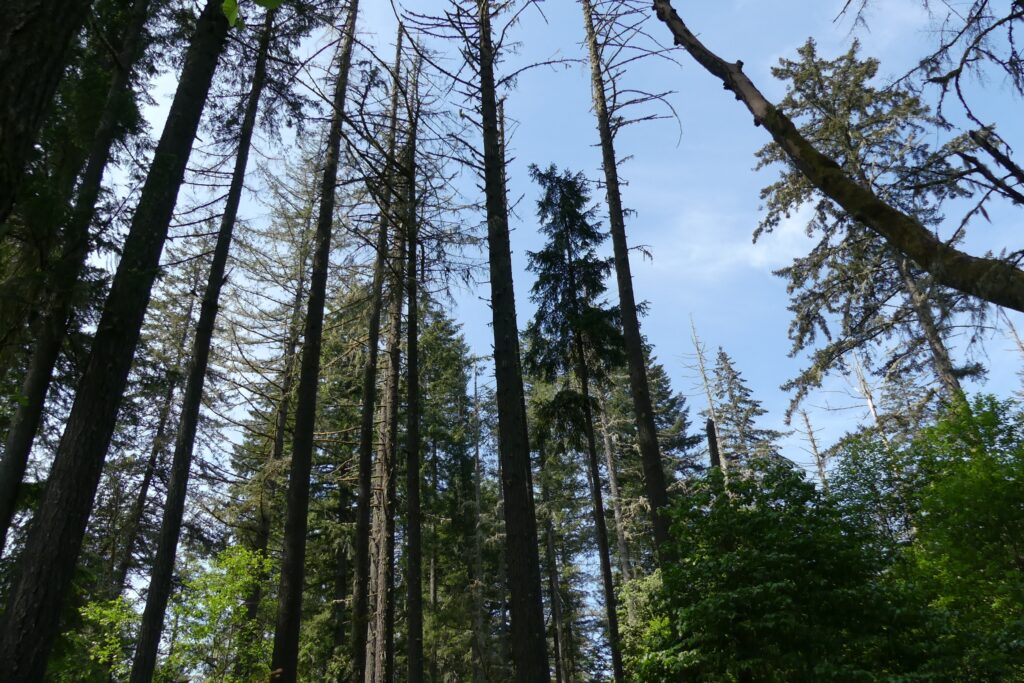
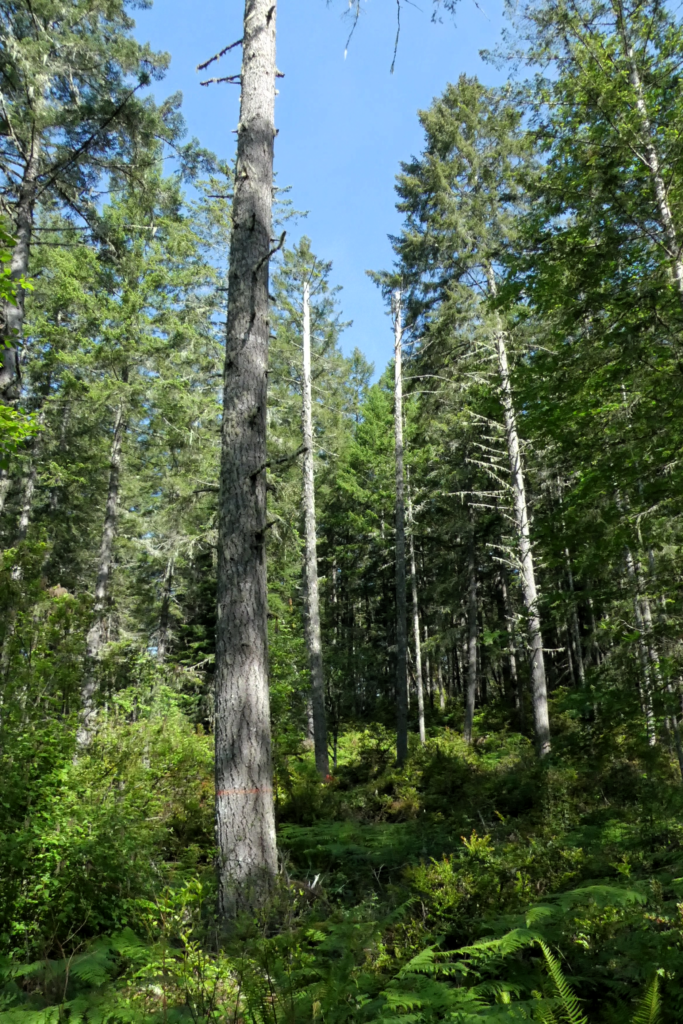
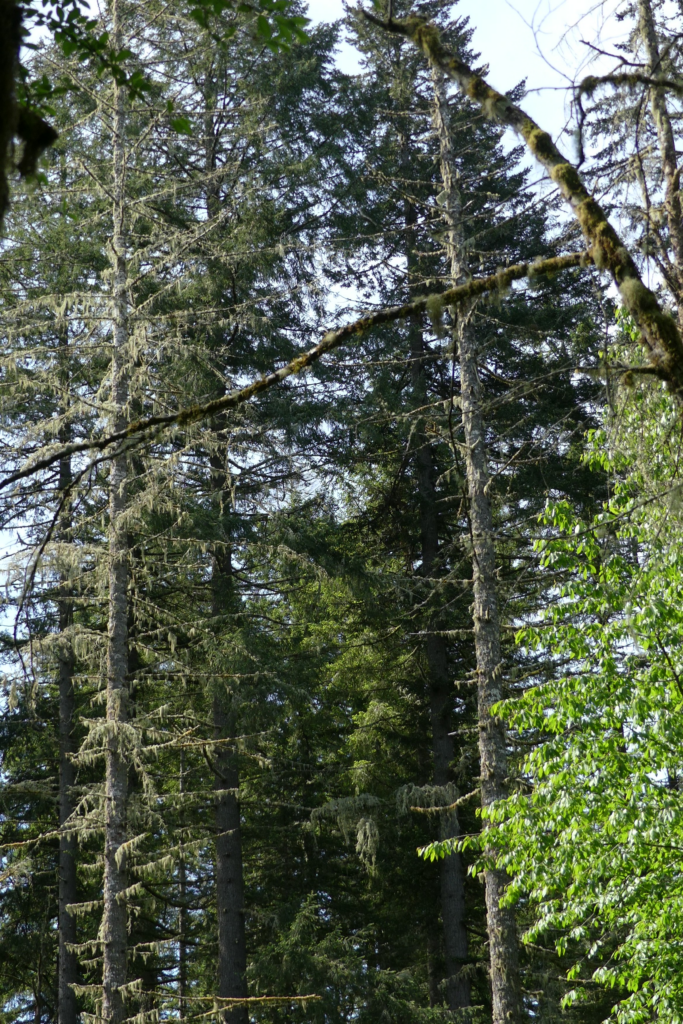
Laminated root rot (a fungal disease endemic to the Pacific Northwest) requires active management to prevent its spread. On Kit’s property, pockets of Douglas-Fir snags clearly indicate the pathogen’s presence.
As climate change continues to exacerbate native habitat loss in the Pacific Northwest, restoration practitioners must make informed decisions on how (and if) climate-adapted plant materials should be used in restoration projects.
To learn more about assisted migration in action, read NNRG’s adaptive restoration at Stossel Creek. Planning your own assisted migration project? Check out the Assisted Migration Best Management Practices for Pacific Northwest Habitat Restoration Projects by the Forest Adaptation Network.
Leave a Reply