
Running the meter back—into the future
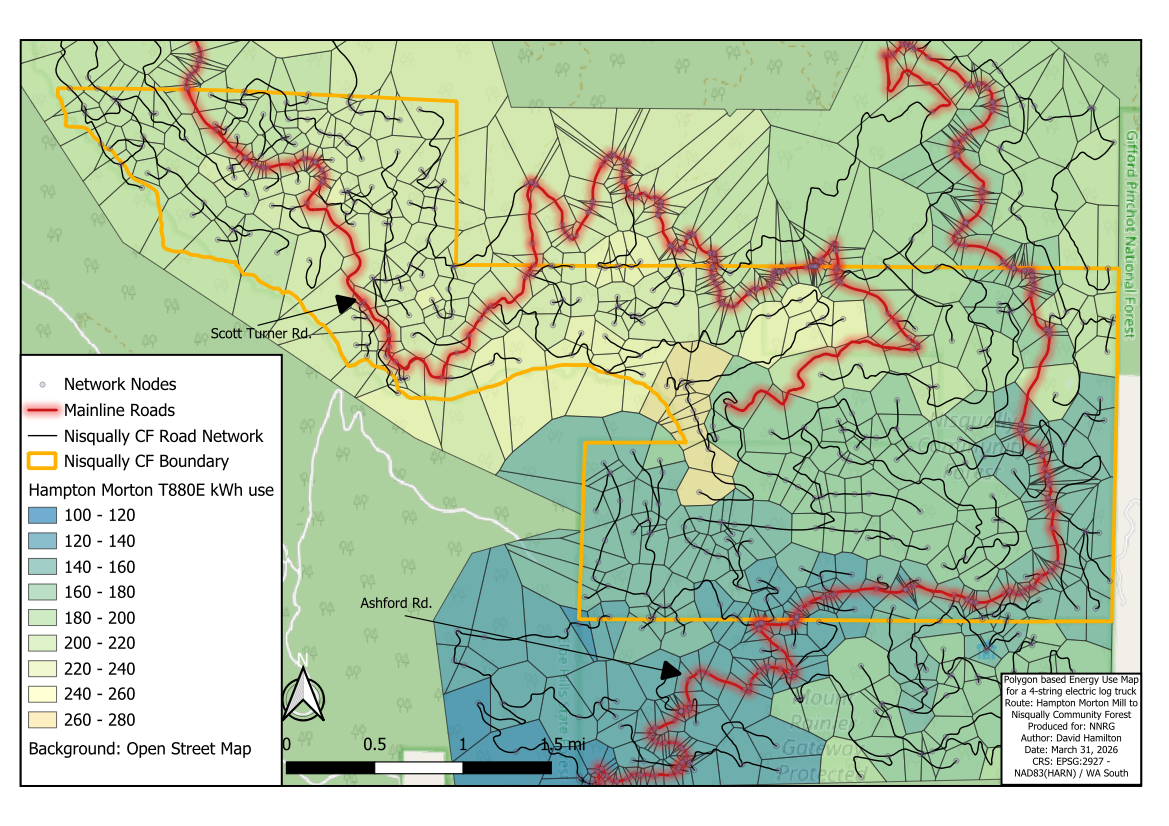
The idea first came to me when I was riding downhill from the Nisqually Community Forest with one of our foresters in his new Subaru Solterra, a small electric SUV. By the time we reached the flatlands, the dashboard gauge of the vehicle’s remaining range had actually crept up a few miles, thanks to regenerative braking that fed power back to the battery.
But what if we’d been driving a log truck, I mused. We would have driven downhill laden with logs, dropped them off at the mill, and driven back up to the forest in an empty — and much lighter — rig. We could reap the benefits of a one-way descent through Earth’s gravity, just like river water flowing through a hydropower turbine. Would it be possible, I wondered, to meaningfully extend the truck’s range with the energy recaptured by braking?
As is so often the case with random ideas, I wasn’t the first to think of it. It turns out that researchers at Oregon State University had been investigating the parameters, developed some models, and tested them with trucks (though not log trucks).
On the surface, the situation looked promising. The Nisqually Community Forest, where we oversee timber harvest and other forest stewardship work, is located at elevations of 2,800 to 4,500 feet above sea level, while the logs are destined for mills and chipping yards at 500 to 1,000 feet. Dusting off my physics textbook, I reckoned that the net energy available from the logs’ descent might be as much as 60 or 70 kilowatt-hours — on par with the total capacity of the Solterra’s battery. But we didn’t know whether that was a little or a lot compared to the capacity of a battery big enough to power a log truck.
With support from the Centralia Coal Transition Grants (established by TransAlta as part of the agreement to phase out coal-fired generation in Centralia), we enlisted the OSU researchers and set out to explore whether this notion might translate into a feasible project. Besides the physics, which seemed straightforward, there were engineering questions about how efficiently the energy could be recaptured and fed back into the battery. And it wasn’t as though the mills were located right at the bottom of the hill — the trucks would still have to travel another 25 to 50 miles before they dropped off their logs. Are battery-electric tractors available that have sufficient power and range to fulfill these functions?
Beyond the engineering questions, there were also economic and human ones. It takes a lot longer to charge a truck battery than to fill a tank of diesel — how would that fit into the truckers’ work day? Where would the truck be parked to charge overnight, and would the most convenient and secure places to park it — lumber mills — be amenable to installing a charger? And finally, would it be economically feasible to switch from diesel to electrons?
Now, six months later, we have some preliminary answers. Washington truck manufacturer Paccar has a heavy-duty truck in production, the T880e, which can be outfitted to haul a log trailer, and has a nominal range of 100 to 250 miles depending on how many battery packs it’s equipped with.
For loads leaving the Nisqually Community Forest, OSU researchers estimate that net gain from regenerative braking in electric log trucks would extend the trucks’ range by an average of 50 percent, from as little as 35 percent farther between charges to as much as 69 percent. Besides saving on electricity, their finding means a log truck could travel further on fewer battery packs, which in turns translates into hauling more payload while staying within the truck’s maximum road weight.
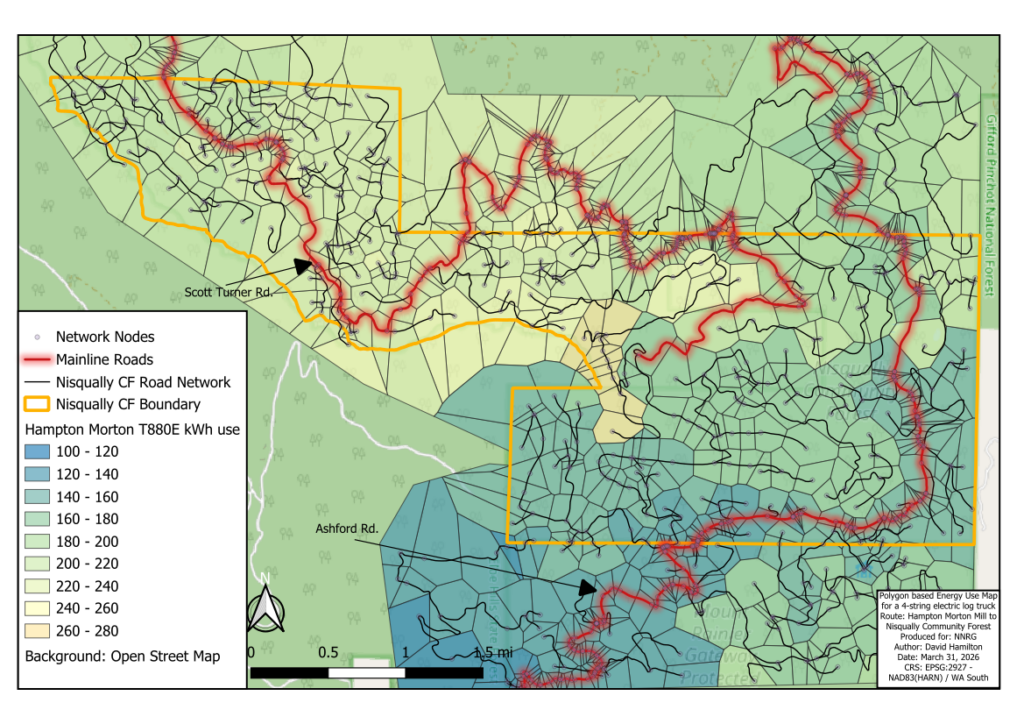
The mills we spoke with were willing to consider installing electric vehicle charging equipment, so the truck drivers would pick up the charged truck at the mill in the morning, and plug it in after they drop off the last load of the day. But some of the most promising findings were the likely economic benefits. The electricity for an average round-trip from mill to forest and back would cost about $19, compared with $86 in fuel for a diesel truck (at 2025 fuel averages, before the recent spike in oil prices). That saving of $67 per load equates to roughly $15 per thousand board feet, or about 2 percent of a typical price for logs at the mill gate.
Those savings depend, however, on how much extra you have to pay for an electric truck. Based on price quotes we got from our local Kenworth dealer, the extra cost is substantial: about $240,000 for the four-battery-pack version, and $190,000 for the three-pack. But now comes the Washington Zero-emissions Incentive Program (WAZIP), with its voucher for the purchase of electric medium- and heavy-duty trucks, paid for with fees on carbon emissions collected under Washington’s cap-and-invest program. A WAZIP voucher will knock $175,000 off the purchase price at point of sale, making the extra price for the electric model just $65,000 for the larger and $15,000 for the smaller battery capacity. With a price difference like that, it could take as little as 225 trips before the fuel savings paid off the extra cost of the electric truck, even before taking into account the savings from, say, never having to change the oil.
As with all innovations, the key will be seeing how the technology actually works in field conditions. One of NNRG’s roles in the forestry ecosystem is to be a pioneer in testing new approaches to forest stewardship across all its elements. In the next phase of this project, NNRG is pursuing funding to test how closely actual performance tracks the theory. We’d lease the truck to local log haulers, so they could each get a risk-free turn for several months to see how they like it and whether it performs well for them, while the OSU researchers collect data to calibrate their models.
With the economics of thinning as precarious as they are, anything that reduces the cost of hauling can make marginally viable thinnings more feasible, and help forest stewards keep their woods healthy and growing.
You can access the report by clicking the button below.
Leave a Reply